
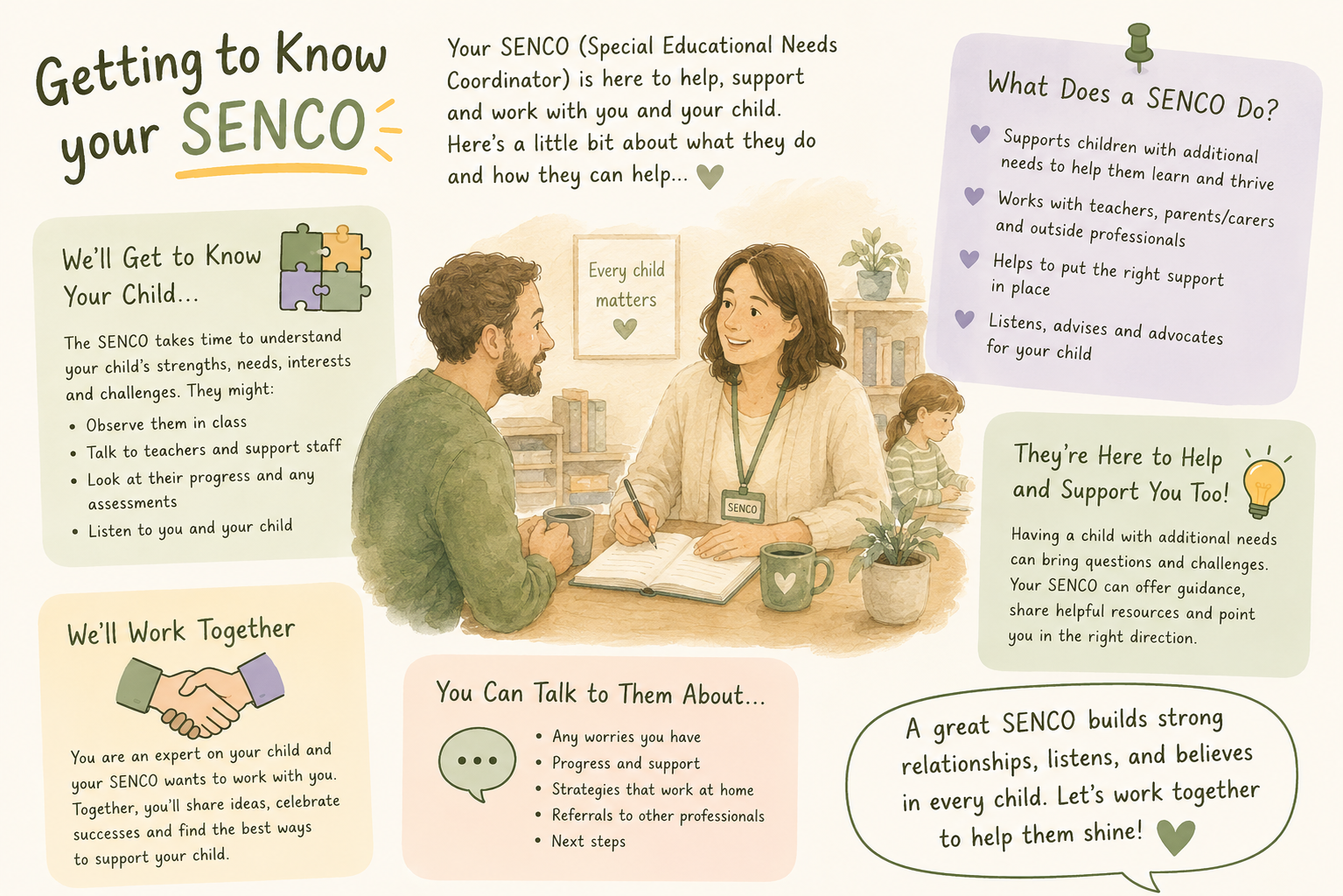
Getting to Know Your SENCo: A Parent's Guide
If you have concerns about your child's learning, one of the most important steps you can take is building a good relationship with your school's SENCo — their Special Educational Needs Coordinator. As someone who worked as a SENCo for many years, I know firsthand that we genuinely want to help. The door is almost always open, and a good conversation early on can make a real difference to the support your child receives.
What is a SENCo?
Every maintained school in England is required to have a designated SENCo. They are responsible for coordinating support for children with special educational needs and disabilities, working alongside class teachers, support staff, and external specialists. Additionally, they act as the key point of contact for parents navigating the SEND system.
Why talking to your SENCo matters
It's important that you engage and talk to your school's SENCo to find out how the school can support your child. Many parents feel unsure about making that first approach, but you don't need to have all the answers before you get in touch. Simply sharing your concerns is enough to start the conversation.
It's also vital that you provide the school with any information you already have. If your child has had a previous assessment, a medical diagnosis, or a report from another professional, share it. The more context the SENCo has, the better placed they are to put the right support in place.
What is the school obliged to do?
Schools have a legal obligation to identify and support needs where possible. If your child is receiving SEN support, you are entitled to ask for a written plan — sometimes called a SEN Support Plan or an individual learning plan — that sets out clearly what provision your child will receive, who is responsible for delivering it, and how progress will be reviewed.
It's worth being aware of the definition set out in the SEND Code of Practice at 6.15, which states that a pupil has SEN where their learning difficulty or disability calls for special educational provision — namely, provision that is different from or additional to that normally available to pupils of the same age. If your child meets this definition, the school has a duty to act.
What if you're not sure whether your child has SEN?
That uncertainty is completely normal and very common. You don't need a formal diagnosis to approach your SENCo — in fact, it's often better to start that conversation before one. A good SENCo will listen to your concerns, observe your child, and work with their teachers to build a clearer picture. If a formal assessment is needed further down the line, they can help signpost you in the right direction.
What to ask at your first meeting
Going in with a few questions prepared can help you feel more confident. Consider asking:
- What concerns, if any, has the school already identified?
- What support is currently in place, or what could be put in place?
- Is there a written plan, and can I have a copy?
- How will progress be monitored and reviewed?
- When can we meet again to discuss how things are going?
A note from experience
Having spent many years as a SENCo, I can honestly say that the parents who got the best outcomes for their children were rarely the ones who shouted the loudest — they were the ones who came in, shared what they knew, asked good questions, and worked alongside the school as partners. SENCos are on your side. We want the same thing you do.
If you have concerns about your child's learning and aren't sure where to start, feel free to get in touch. Sometimes a short conversation is all it takes to point you in the right direction.