
Adults and Dyslexia — It's Never Too Late to Get Answers
Many adults living with dyslexia have spent years wondering why certain things feel harder than they should. Reading takes longer. Writing is exhausting. Spelling never seems to stick. And despite being capable, intelligent people, there is a persistent sense of having to work twice as hard just to keep up.
If any of that sounds familiar, you are not alone — and you are not too late.
You didn't miss the window
Dyslexia is not a childhood condition. It is lifelong, and that means it can be identified and supported at any age. Many adults reach their thirties, forties, fifties and beyond before anyone joins the dots. Some were told at school they were lazy or not trying hard enough. Others simply slipped through without anyone noticing. Additionally, many developed such effective coping strategies that their difficulties were masked entirely — until the pressure of work, university, or daily life made those strategies harder to sustain.
A formal assessment as an adult doesn't change your past. But it can change how you understand yourself — and what becomes possible next.
How much does an
assessment cost?
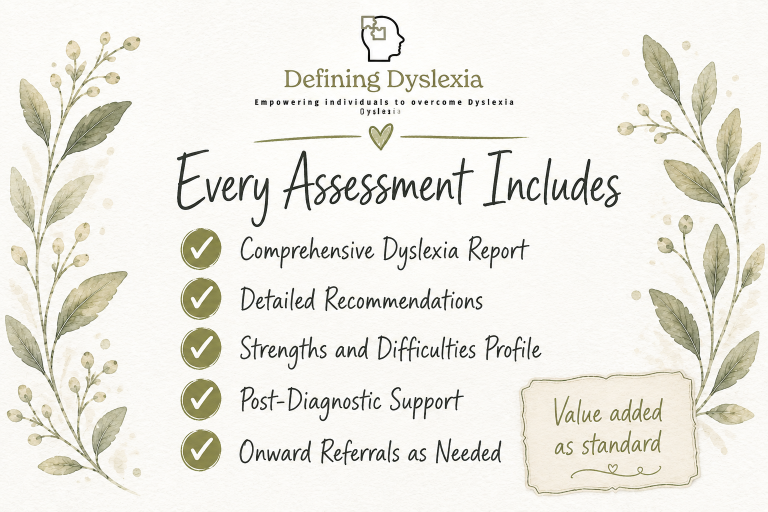
A full dyslexia assessment with Defining Dyslexia costs £495. This includes the assessment session and a comprehensive written report with practical recommendations. There are no hidden costs and no additional charges.
Assessments can be carried out in your home, at your child's school, or at a suitable venue local to you. Where a venue needs to be booked, a small additional fee may apply. This will always be discussed and agreed with you before anything is confirmed.
For adult assessments that include screening for co-occurring conditions such as ADHD or dyspraxia, a small additional fee also applies. This will be discussed with you at enquiry stage.
If you would like to talk through costs before booking, you are very welcome to get in touch.
Tagline
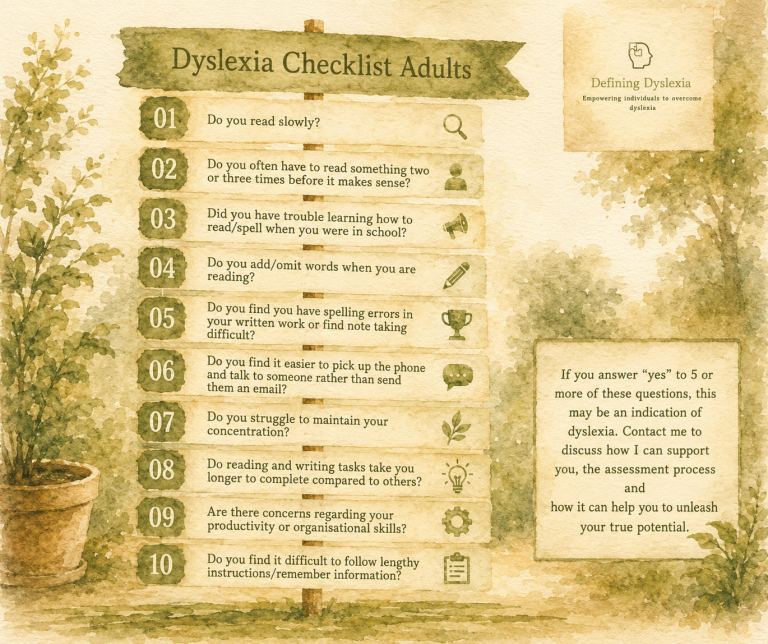
What might dyslexia look like in adults?
Every adult with dyslexia has a different profile, but common experiences include:
- Taking significantly longer to read than peers
- Spelling inconsistently, even common words
- Struggling to organise written work or express thoughts clearly in writing
- Difficulty following multi-step instructions or remembering sequences
- Finding it hard to take notes whilst listening
- Avoiding tasks that involve reading or writing where possible
- A strong verbal ability that doesn't translate into written work
- A sense of having to work much harder than others for the same results
If several of these feel familiar, a formal assessment could give you the clarity you have been looking for.
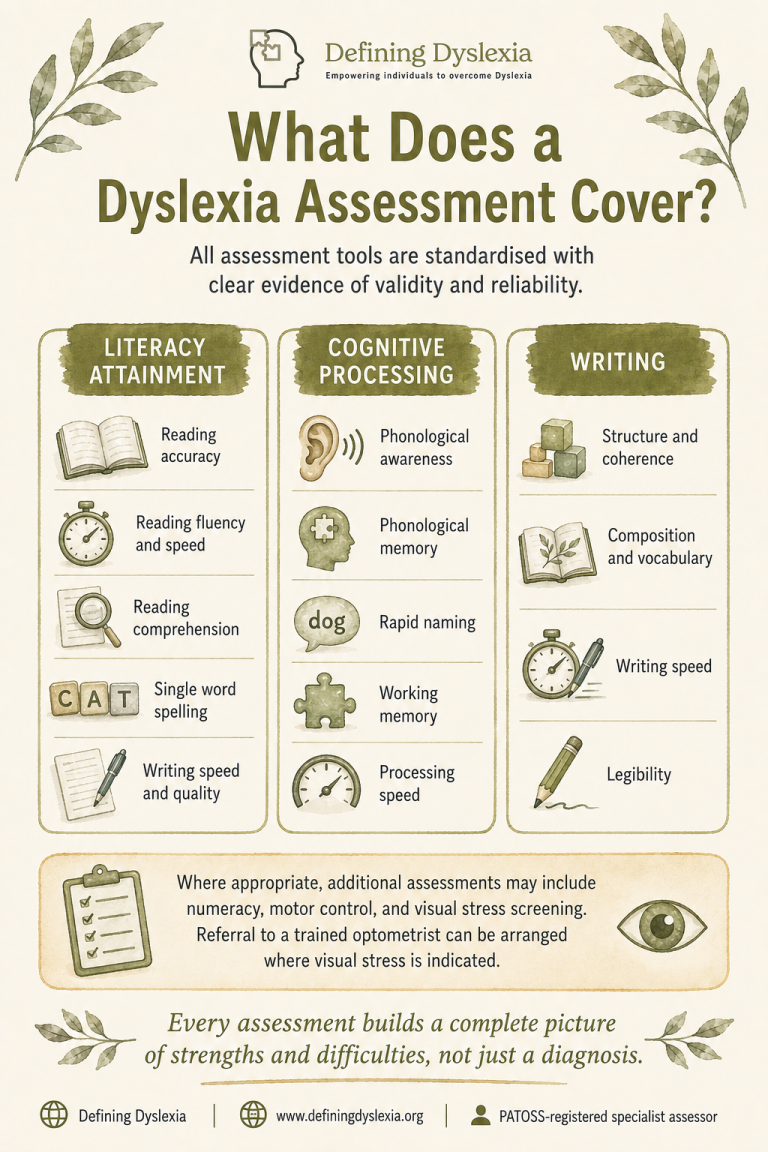
What does an adult dyslexia assessment involve?
An assessment with Defining Dyslexia is a thorough, professional, and entirely non-judgmental process. It looks at your cognitive profile (including phonological processing, working memory, processing speed, and reasoning) alongside standardised literacy testing. Together these build a complete picture of how your brain works and where the specific difficulties lie.
The assessment typically takes around two to three hours and is followed by a comprehensive written report. That report includes a clear profile of your strengths and difficulties, a formal identification where the evidence supports it, and practical recommendations tailored specifically to you.



What can a
diagnosis unlock for adults?
A formal dyslexia report carries real weight — and opens real doors.
In the workplace — you may be entitled to workplace adjustments under the Equality Act 2010. Additionally, Access to Work funding from the government can provide practical support including assistive technology, coaching, and other adjustments at no cost to you or your employer.
At university — a formal assessment report is required to access Disabled Students' Allowance, which funds specialist equipment, software, study skills support, and exam adjustments. Universities consistently accept privately commissioned assessment reports without question.
In daily life — perhaps most importantly, a diagnosis gives you a framework for understanding yourself. Many adults describe the experience of finally having an answer as genuinely life-changing — not because it changes who they are, but because it explains so much that previously made no sense.
Dyslexia rarely travels alone
Many adults who are assessed for dyslexia discover that their profile is more complex than they expected. Around 40% of people with dyslexia also have ADHD — and up to 50% have some degree of dyspraxia (also known as Developmental Coordination Disorder). Understanding whether these conditions are present alongside dyslexia is not a minor detail. It can fundamentally change how you understand yourself and what support is most useful.
ADHD in adults
ADHD is still widely misunderstood as a childhood condition — and particularly as one that affects hyperactive boys. In reality, ADHD presents very differently in adults, and is significantly underidentified in women. Common experiences include persistent difficulties with focus and concentration, a tendency to lose track of tasks or switch between them without completing them, impulsivity, emotional dysregulation, and a sense of time that feels unreliable or hard to manage.
Many adults with ADHD describe a lifetime of being told they are disorganised, forgetful, or not living up to their potential. They may have developed sophisticated coping strategies that mask their difficulties in some areas whilst leaving others completely unmanaged. Additionally, the overlap between ADHD and dyslexia ( particularly around working memory and processing speed) means that the two conditions frequently reinforce each other, making both harder to identify and harder to support without understanding the full picture.
Whilst Defining Dyslexia does not provide a formal ADHD diagnosis, a dyslexia assessment will consider the cognitive profile carefully. Where the evidence suggests ADHD traits are present and significantly affecting daily life, the report will reflect this and appropriate onward referral can be discussed.
Dyspraxia in adults
Dyspraxia affects motor coordination, spatial awareness, and the planning and sequencing of movement. For adults, this can show up as difficulties with driving, coordination in sport or everyday physical tasks, handwriting that remains effortful and unclear, and challenges with spatial organisation — such as navigating new environments or judging distances. Additionally, dyspraxia often affects the ability to organise thoughts and sequence information, which can look very similar to some aspects of dyslexia and ADHD.
Many adults with dyspraxia were simply described as clumsy or disorganised as children. The condition remains significantly underdiagnosed in adults — particularly in those who have found ways to work around their difficulties without ever understanding why those difficulties exist.
As with ADHD, a dyslexia assessment will consider whether dyspraxia traits are part of the picture. Where they appear significant, the report will acknowledge this and recommendations will take the full profile into account.


Why the full picture matters?
Supporting dyslexia without understanding co-occurring ADHD or dyspraxia rarely works as well as it should. Equally, managing ADHD without recognising the dyslexia underneath it leaves significant gaps. The most useful assessment is one that looks at the whole person — not just the presenting difficulty — and provides recommendations that reflect everything that is going on.
Where are assessments available?
Face-to-face assessments for children are available across two regions (South Yorkshire and Cambridgeshire) covering a wide area across both. Remote assessments are available for families anywhere in the UK.
South Yorkshire and surrounding areas
Cambridgeshire and surrounding areas
Anywhere in the UK
About Your Assessor
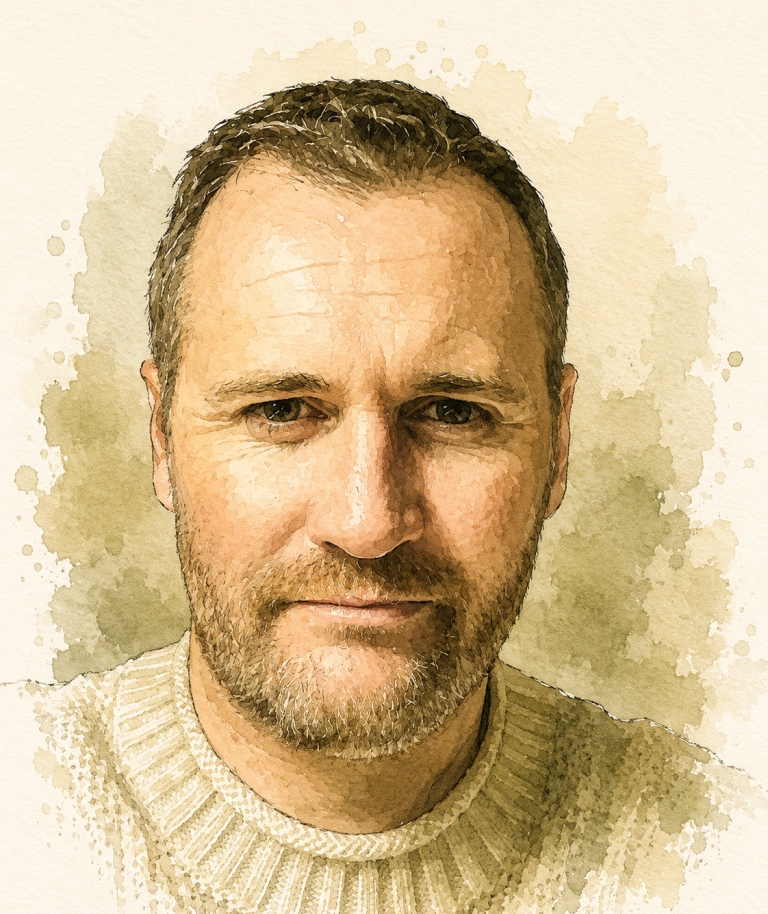
Every Defining Dyslexia assessment is carried out by Mark, a PATOSS-registered specialist assessor with fifteen years of experience supporting children, young people, and adults with dyslexia and other learning differences. Mark holds an APC and works to the standards set by SASC, the body that governs SpLD assessment quality across the UK. Mark's background as a former SENCo means he understands the school system from the inside, and brings that knowledge to every assessment and report he writes.
E-mail: Mark@definingdyslexia.org
We operate virtually across the UK, providing accessible support wherever you are. For in-person appointments, we serve Sheffield, Peterborough, and the surrounding area. Contact us to learn more!