What is an SpLD and How is it Different to Dyslexia?
If you've been looking into support for your child's or your learning difficulties, you've probably come across the term SpLD and wondered exactly what it means. It's one of those pieces of educational jargon that gets used frequently but rarely gets properly explained. This guide aims to clear that up simply and honestly.
What does SpLD stand for?
SpLD stands for Specific Learning Difficulty. It's an umbrella term used to describe a family of learning differences that affect specific areas of learning rather than overall ability. The word "specific" is important here — it means the difficulty is focused on particular skills such as reading, writing, spelling, or processing speed, rather than reflecting a general learning delay across all areas.
A child or adult with an SpLD will typically have areas of genuine strength alongside their areas of difficulty. This profile of uneven ability is one of the defining characteristics of an SpLD, and it's also one of the reasons these difficulties can sometimes go unnoticed for so long. A bright child who struggles significantly with spelling may simply be seen as careless rather than as someone with a genuine specific learning difficulty.
What conditions fall under the SpLD umbrella?
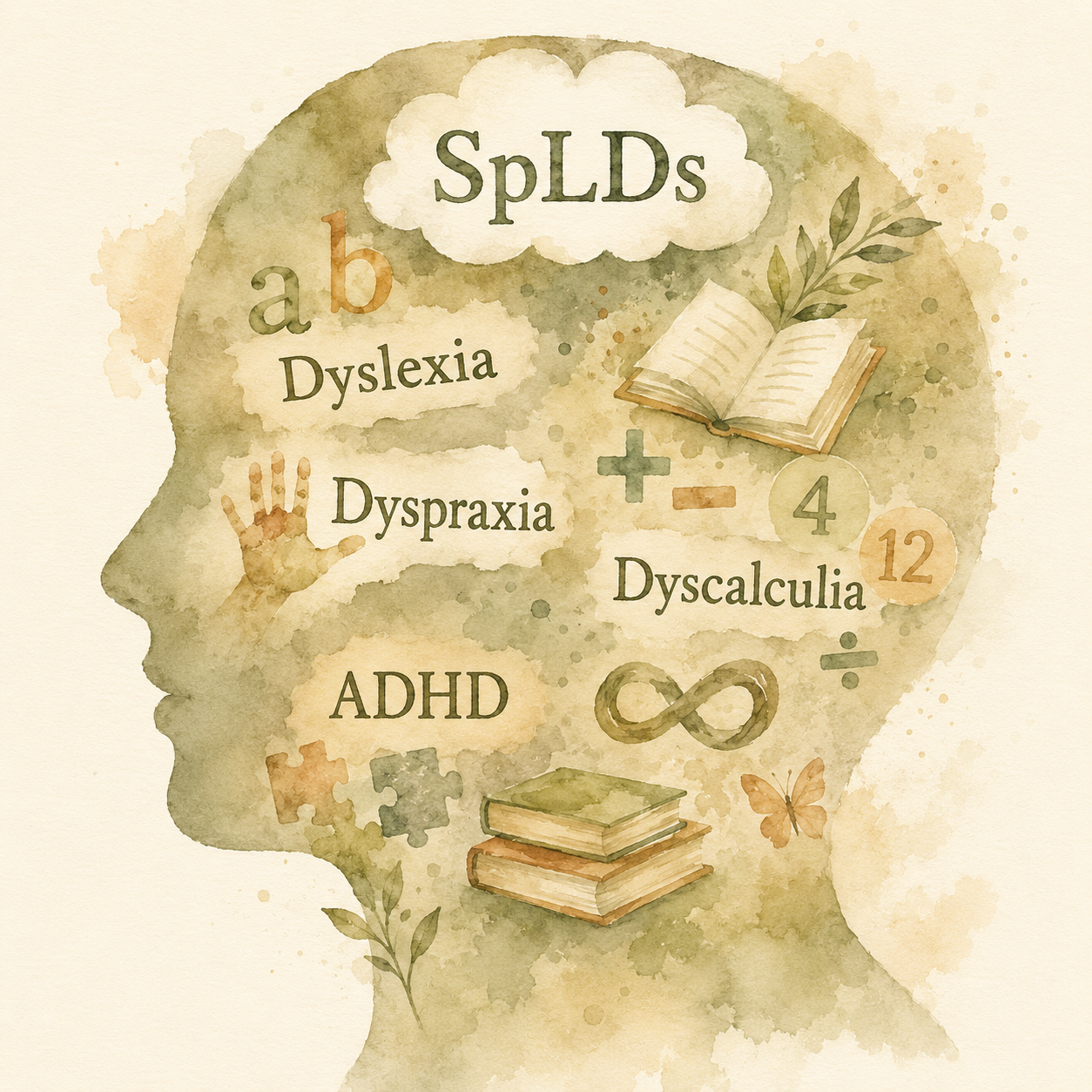
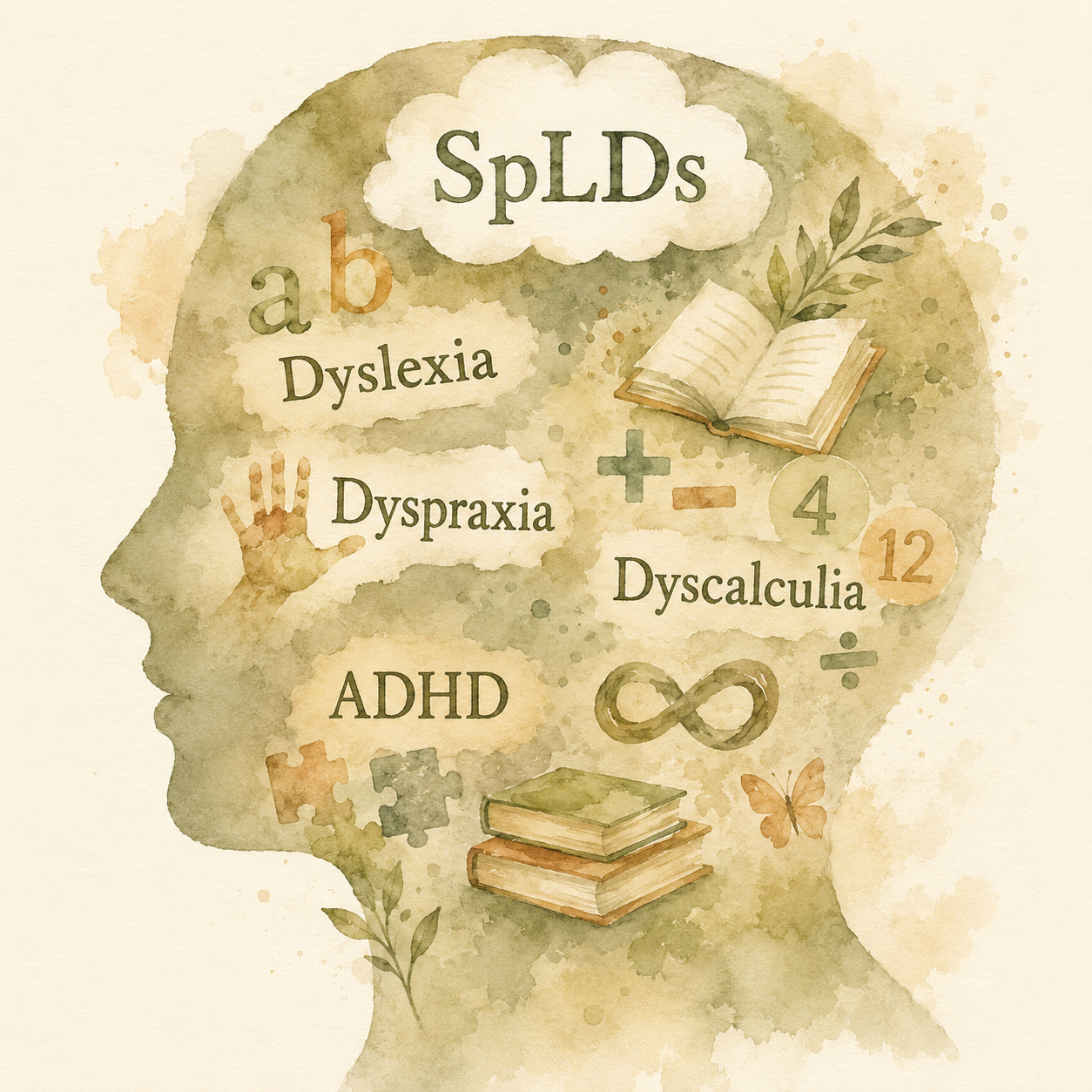
SpLD covers several distinct but related conditions. Dyslexia is the most widely known and primarily affects reading, writing, and spelling. Dyspraxia, also known as Developmental Coordination Disorder or DCD, affects motor coordination and can impact handwriting, organisation, and physical tasks. Dyscalculia affects the ability to understand and work with numbers and mathematical concepts. Attention Deficit Hyperactivity Disorder, or ADHD, affects attention, impulse control, and, in some cases, hyperactivity. Dysgraphia specifically affects the physical act of writing and the ability to express thoughts in written form.
It's also worth noting that these conditions frequently overlap. A child assessed for dyslexia may also show characteristics of dyspraxia or ADHD, and a thorough assessment will take the full picture into account rather than focusing narrowly on a single label.
So what is dyslexia specifically?
Dyslexia is the most commonly identified SpLD. It is a neurological condition that affects the way the brain processes written and spoken language, specifically the ability to decode words, process phonological information, and develop accurate and fluent reading and spelling skills.
Crucially, dyslexia is not related to intelligence. Many people with dyslexia have above-average ability in reasoning, creativity, and problem-solving. The difficulty lies specifically in the processing of written language, not in understanding or thinking.
Dyslexia affects around ten percent of the population to varying degrees, making it the most prevalent of the SpLDs and the one most likely to be identified during a child's school years.
How is a formal SpLD assessment different to a dyslexia screening?
A dyslexia screening is a brief tool that flags whether further investigation might be warranted. It can be useful as a first step, but it cannot diagnose dyslexia or any other SpLD, and it doesn't produce a report that carries weight with schools, exam boards, or universities.
A formal SpLD assessment is a comprehensive one-to-one evaluation carried out by a specialist assessor holding an Assessment Practising Certificate. It looks across multiple areas of cognitive processing and learning, considers the full profile of strengths and difficulties, and results in a detailed written report with specific recommendations. It is the only route to a formal diagnosis and the support that follows from one.
Why does the label matter?
Some parents wonder whether getting a formal diagnosis is really necessary, particularly if their child is already receiving some support at school. The label itself is less important than what comes with it. A formal SpLD assessment gives you a clear, evidence-based understanding of how your child learns, opens the door to exam access arrangements, provides a foundation for school support planning, and gives your child themselves a framework for understanding their own mind.
A Final Word
For many children, and indeed many adults, understanding that their difficulties have a name and an explanation is genuinely empowering. It shifts the narrative from "I'm not clever enough" to "I process things differently" — and that shift can make a profound difference to confidence and motivation.
How Defining Dyslexia can help?
At Defining Dyslexia, we carry out formal SpLD assessments for children, young people, and adults. Our assessments follow SASC guidance and are carried out by a PATOSS-registered specialist assessor with fifteen years of experience. We look at the full picture rather than focusing narrowly on a single condition, ensuring that the report you receive genuinely reflects your child's individual profile.
Face-to-face appointments are available across Sheffield and South Yorkshire and across Peterborough and Cambridgeshire, with remote assessments available for families and adults anywhere in the UK.
If you'd like to find out more or discuss whether an assessment is the right step, please get in touch.