My child is so bright, but is struggling to read?
Empowering Families on the Journey
At Defining Dyslexia, we recognise the unique challenges that bright children with dyslexia face. Our aim is to provide parents with a wealth of comprehensive insights designed to empower families as they navigate the complexities of reading difficulties. Through our evidence-based strategies, we offer tailored approaches that focus on effective learning techniques specifically crafted to meet the diverse needs of each child.
Understanding dyslexia is key to unlocking your child’s true potential. We believe that every child deserves the opportunity to thrive academically, and we are committed to equipping parents with essential information about dyslexia, including its characteristics and effects on learning. Additionally, our bespoke assessments are designed to identify specific strengths and areas for improvement, guiding families towards the most effective strategies to support their child's educational journey.
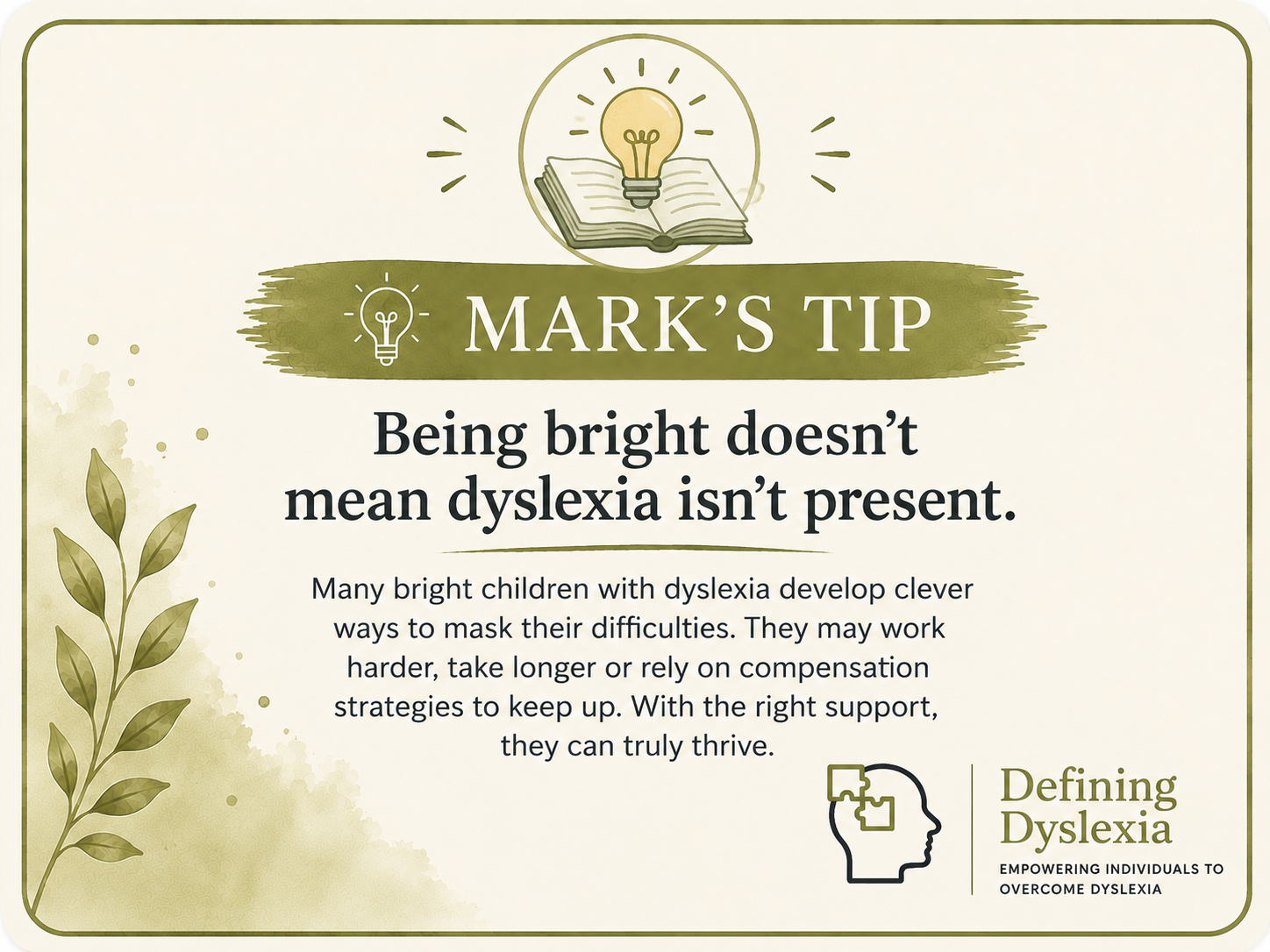
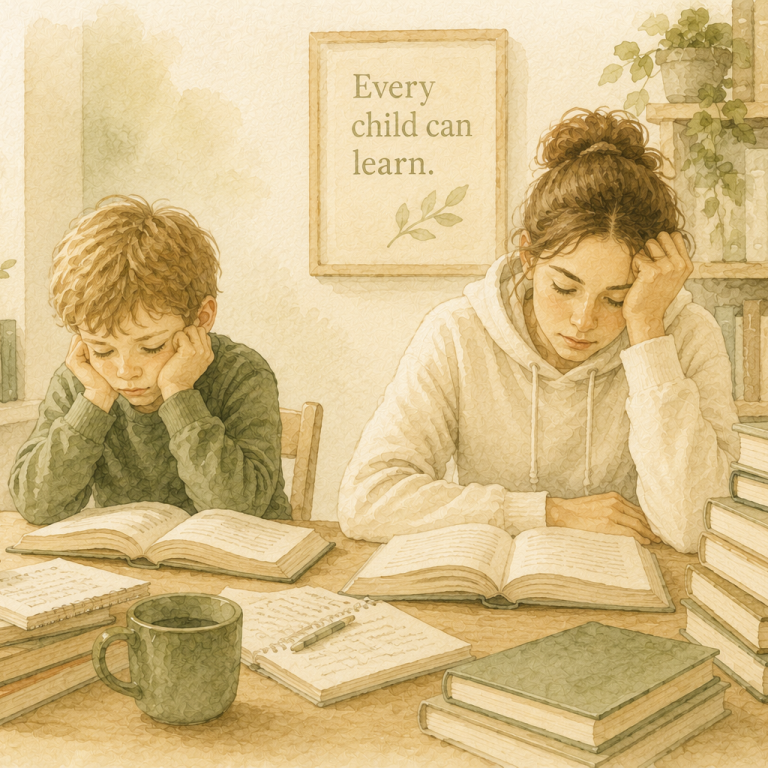
Dyslexia affects around 10% of the population and often goes unnoticed in children who compensate using their intelligence, vocabulary, and reasoning skills.
When reading doesn’t match your child’s potential. Could this be your child?
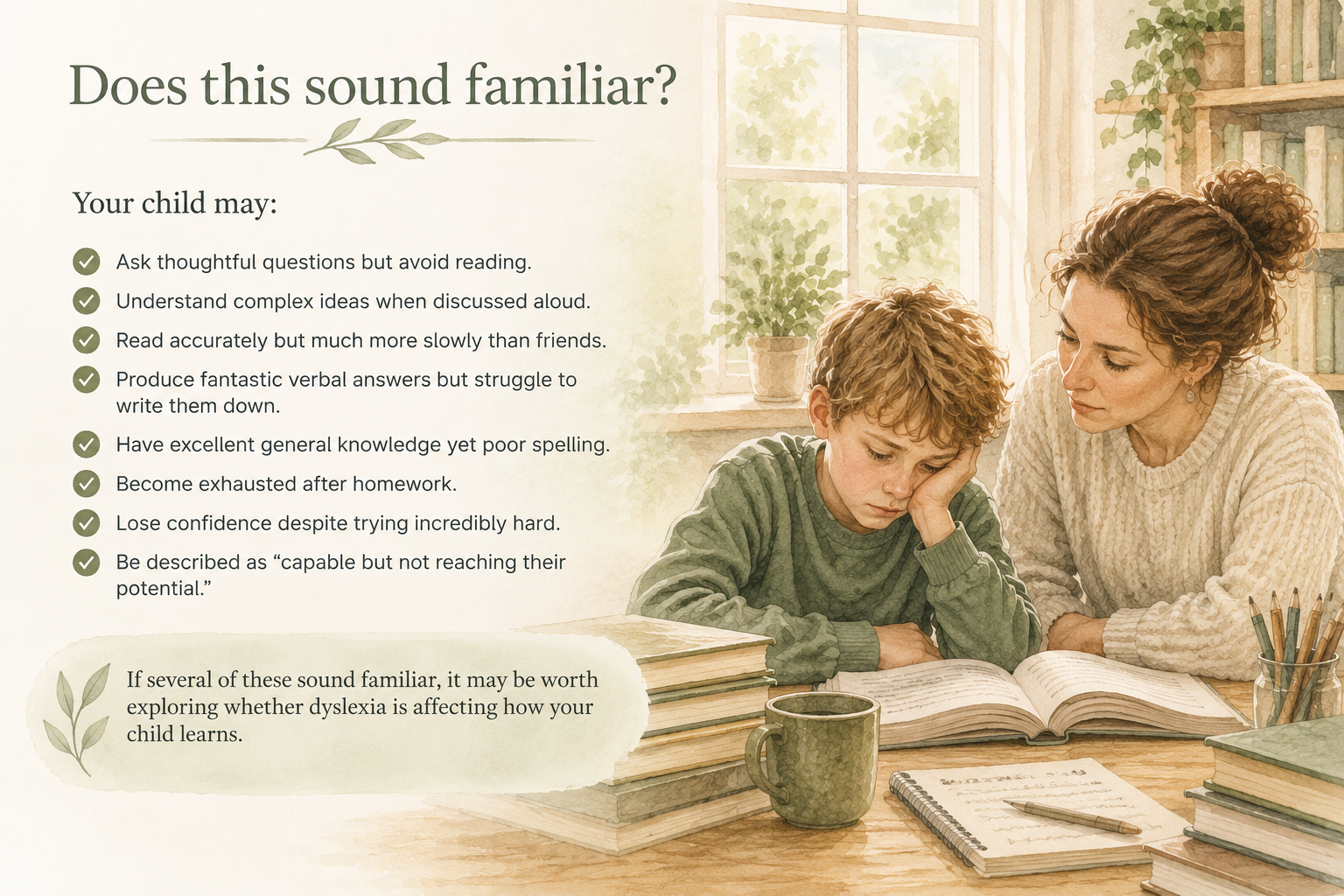
Why can a bright child still struggle to read?
It can seem confusing when a child is bright, curious, and articulate, yet finds reading much harder than expected. Many parents wonder how their child can excel in some areas while continuing to struggle with literacy.
The answer lies in the fact that intelligence and reading ability are not the same thing.
Children with dyslexia often have many strengths, including strong reasoning skills, excellent spoken language, creativity, and problem-solving abilities. These strengths can help them compensate for difficulties with reading and spelling, meaning they may appear to be coping well despite investing far more effort than their peers.
Reading depends on a range of underlying skills developing efficiently. When one or more of these skills, such as phonological awareness, rapid word recognition, or reading fluency, is less automatic, reading can become slow, effortful, and tiring. This can happen even when a child has excellent comprehension, asks insightful questions, and performs well in other areas of learning.
Understanding how reading develops is often the first step towards understanding why a bright child may still experience reading difficulties.

How does reading actually work?
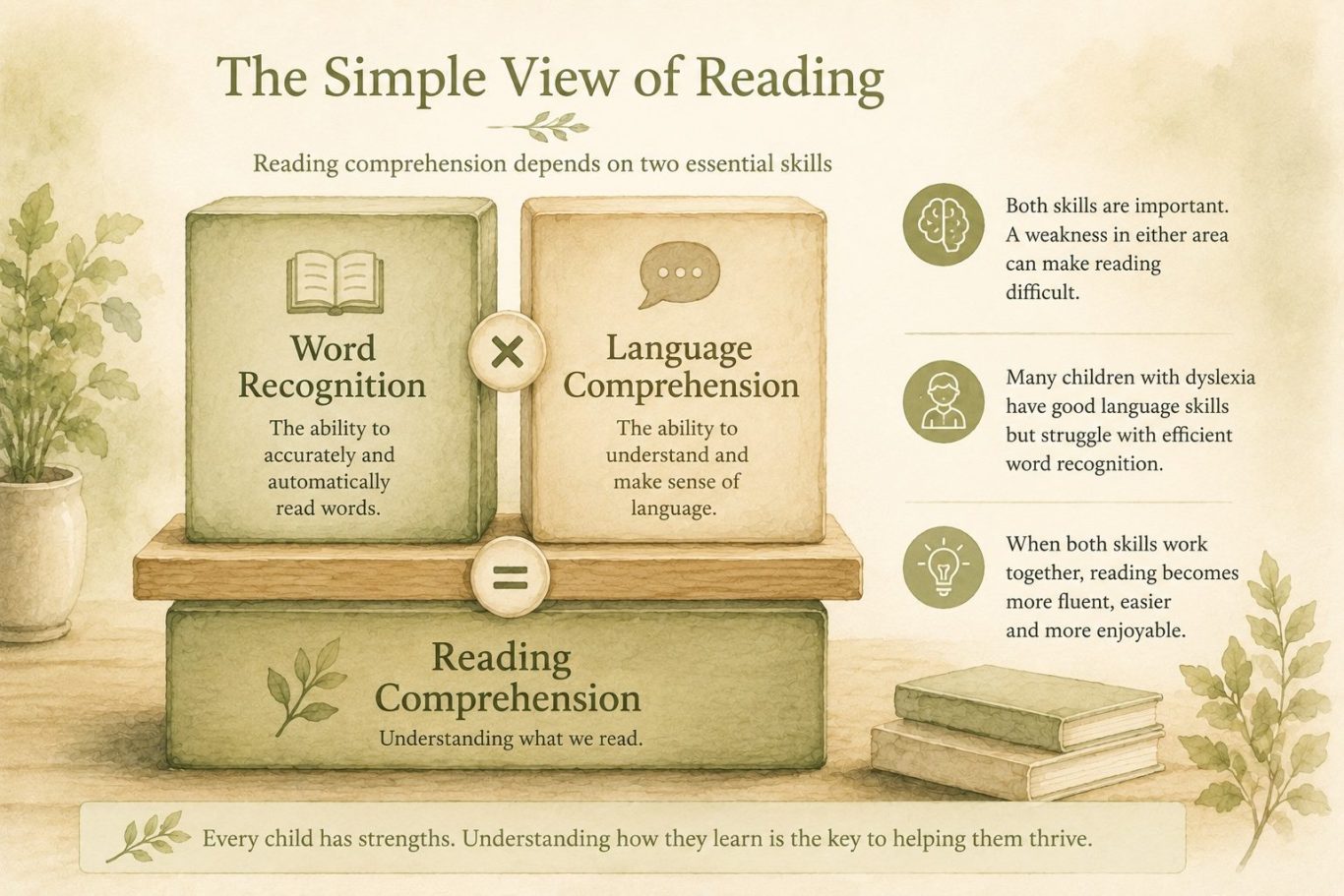
Welcome to the Reading Foundations section at Defining Dyslexia, where we explore the essential elements that underpin reading skills. Our aim is to illuminate the Simple View of Reading, a model that clarifies how decoding and comprehension are interrelated components crucial for literacy. By understanding these fundamentals, parents can play a pivotal role in their child's reading journey, ensuring they are well-equipped to thrive in their educational pursuits.
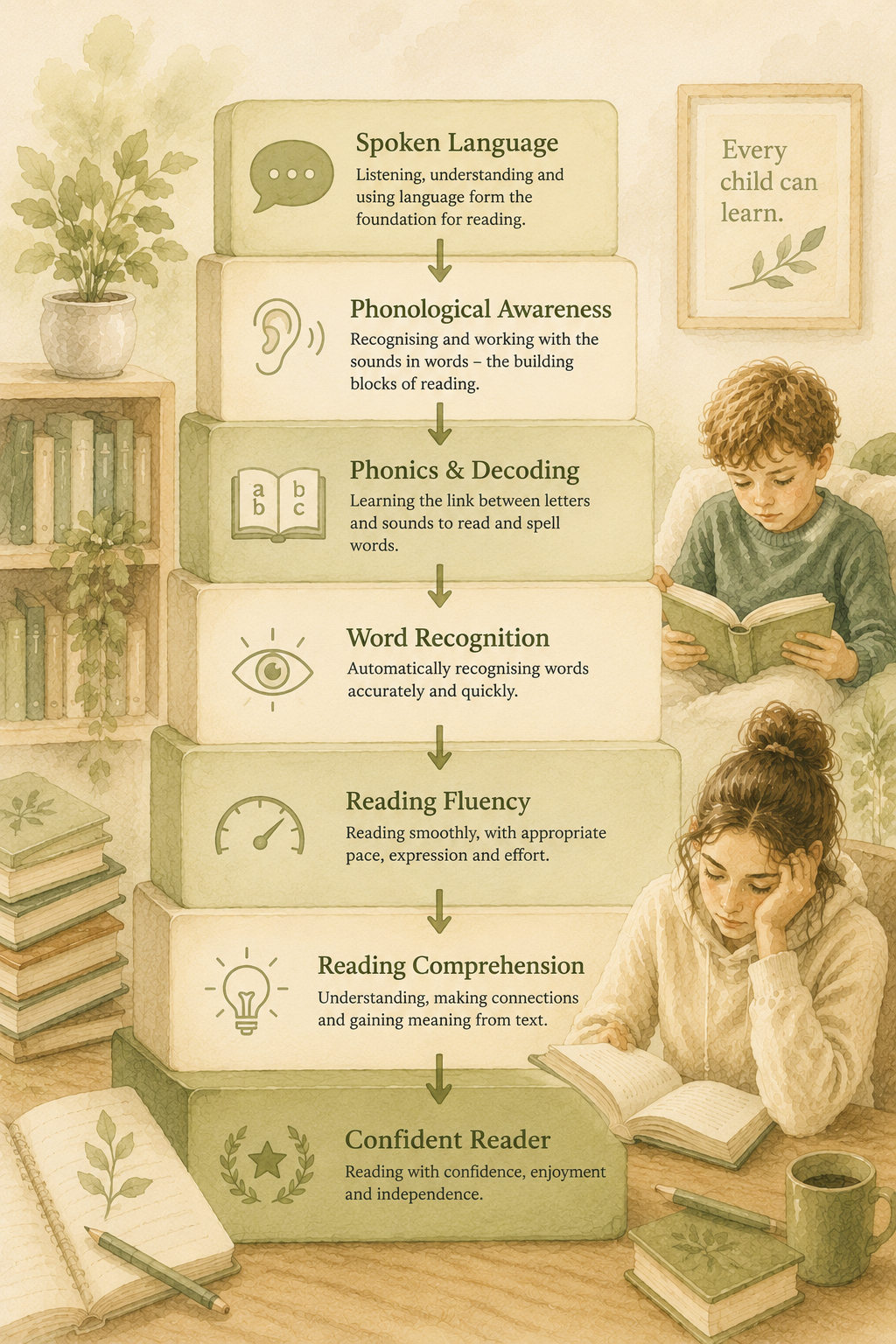
Reading feels effortless for most fluent readers, but it is actually one of the most complex skills the brain has to learn.
Unlike spoken language, which develops naturally, reading must be taught. It relies on several different skills working together automatically.
As children become experienced readers, these skills become so well practised that they no longer have to think about them consciously. When one or more of these skills is less efficient, reading can become slow, effortful, or tiring, even in very bright children.
1. Understanding the Simple View of Reading
One of the most widely accepted models of reading is known as the Simple View of Reading.
It explains that reading comprehension depends on two broad skills:
Reading Comprehension = Word Recognition × Language Comprehension
This means children need to be able to recognise written words efficiently and understand language.
A weakness in either area can affect reading, while strengths in one area may partly compensate for difficulties in another.
For many children with dyslexia, language comprehension is good, but efficient word recognition develops much more slowly.
2. Reading starts with spoken language
Before children ever learn to read, they develop spoken language.
This includes:
- listening
- understanding language
- learning new vocabulary
- recognising speech sounds
- remembering verbal information
Strong spoken language provides an important foundation for reading, although children can still experience reading difficulties even when they are articulate and have an excellent vocabulary.
3. Decoding
The next stage is learning that letters represent sounds.
Children gradually learn to:
- recognise letters
- blend sounds together
- break words apart
- read unfamiliar words
This process is known as decoding.
At first it is slow and deliberate, but with practice it becomes increasingly automatic.
4. Reading Fluency
Once decoding becomes automatic, children begin to read more fluently.
Fluent readers:
- recognise familiar words instantly
- read smoothly
- use expression
- spend very little mental effort identifying words
Instead, their brain can focus on understanding what they are reading.
5. Reading Comprehension
Comprehension is the purpose of reading.
It involves:
- understanding vocabulary
- making connections
- drawing conclusions
- remembering information
- understanding the author’s meaning
Some children understand stories extremely well when someone else reads to them but struggle when reading independently because so much effort is spent recognising the words.
So, why can bright children maybe missed?
A child with excellent vocabulary, reasoning skills, and spoken language may understand everything they hear.
Because of these strengths, they can often work out the meaning of a text even when reading is slow or effortful.
Teachers may therefore see good comprehension and assume reading itself is secure, when in reality the child is investing significantly more effort than their peers simply to recognise the words on the page.
This is one reason why dyslexia can remain hidden, particularly in bright children.
Common Parent Concerns
💭 “School says she’s doing fine…”
Many bright children work much harder than anyone realises. They may appear to be coping at school, but by the time they get home they are mentally exhausted.
Homework often takes far longer than expected because reading, spelling, and organising written work require considerably more effort than for their peers
01
💭 “He understands every story…”
Understanding a story and reading it fluently are two different skills.
Some children have excellent language comprehension but need much more time and effort to recognise the words on the page. This difference is common in children with dyslexia.
02
💭 “But he can read out loud…so surely it can't be dyslexia”
Not necessarily. Reading aloud is only one part of reading. Some children can read accurately but still do so slowly, with much greater effort than their peers.
They may also struggle to recognise familiar words automatically, affecting reading fluency, stamina, and enjoyment, even though they appear to read well.
03
💭 “She gets good marks in class tests…”
Good test results do not always reflect how much effort a child has invested.
Bright children often compensate using strong reasoning, memory, and language skills.
They may achieve expected results while working significantly harder than their classmates, leaving them tired, frustrated, and lacking confidence.
04
💭 “Her spelling is terrible…”
Children with dyslexia often have excellent ideas, imagination, and reasoning skills.
The challenge lies in translating those ideas into written language.
Difficulties with spelling, word retrieval, and written expression can make their work look very different from what they know and understand.
05
💭 “But...She loves books…”
A love of stories does not rule out dyslexia.
Many children enjoy being read to, listening to audiobooks, or discussing books in detail, yet find independent reading slow, tiring, or frustrating.
Enjoying books and finding reading difficult can exist side by side.
06
How much does an
assessment cost?
A full dyslexia assessment with Defining Dyslexia costs £495. This includes the assessment session and a comprehensive written report with practical recommendations. There are no hidden costs and no additional charges.
Assessments can be carried out in your home, at your child's school, or at a suitable venue local to you. Where a venue needs to be booked, a small additional fee may apply. This will always be discussed and agreed with you before anything is confirmed.
For adult assessments that include screening for co-occurring conditions such as ADHD or dyspraxia, a small additional fee also applies. This will be discussed with you at enquiry stage.
If you would like to talk through costs before booking, you are very welcome to get in touch.
Dyslexia assessments and the 11+
If your child is preparing for the 11+, you may be wondering whether difficulties with reading, spelling, processing speed or working under timed conditions could be affecting their performance.
A full diagnostic dyslexia assessment can help to build a much clearer picture of your child’s strengths and difficulties. This can be particularly helpful for children who appear academically able but find that reading, writing or working quickly takes considerably more effort than expected.
An assessment is not simply about gaining extra time in the 11+. A diagnosis of dyslexia does not automatically mean that access arrangements will be awarded. Each grammar school, consortium or testing authority has its own criteria and application process. However, a diagnostic report can provide detailed evidence of your child’s profile and identify where additional support or adjustments may be appropriate.
Where possible, it is helpful to arrange an assessment well before the 11+ registration and access arrangements deadlines. This gives you time to understand your child’s needs, discuss the findings with their school and check the requirements of the particular 11+ provider.
I assess children from age 8+ and regularly work with bright and able children whose underlying literacy or processing difficulties can sometimes be less obvious because they have developed effective ways of compensating.
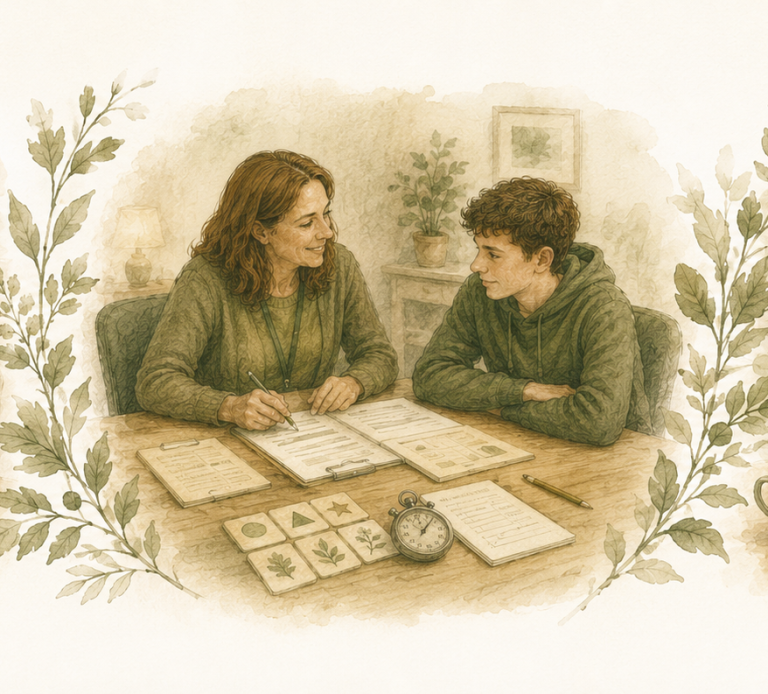
What You Can Expect from a Defining Dyslexia Assessment?
Every assessment is built around you. Here is what makes Defining Dyslexia the right choice for families and individuals.

WHO IT IS FOR?
This guide is for parents who know their child is bright, curious, and capable, yet reading, spelling, or writing never seem as easy as they should.
Whether concerns have been raised by school or you simply feel something isn’t quite right, understanding how your child learns is the first step towards finding the right support.

WHAT WILL YOU LEARN?
Throughout this guide, you’ll discover why intelligent children can still experience dyslexia, how reading develops, why some children are missed for years, and how a diagnostic assessment can provide clarity.
You’ll also find practical advice to help you decide whether an assessment is the right next step.

WHY CHOOSE DEFINING DYSLEXIA?
Every assessment is carried out by a qualified specialist teacher holding a current Assessment Practising Certificate (APC).
Reports are tailored to your child’s individual profile, with clear recommendations for home and school, and post-diagnostic support is included as standard because understanding the report is just as important as receiving it.
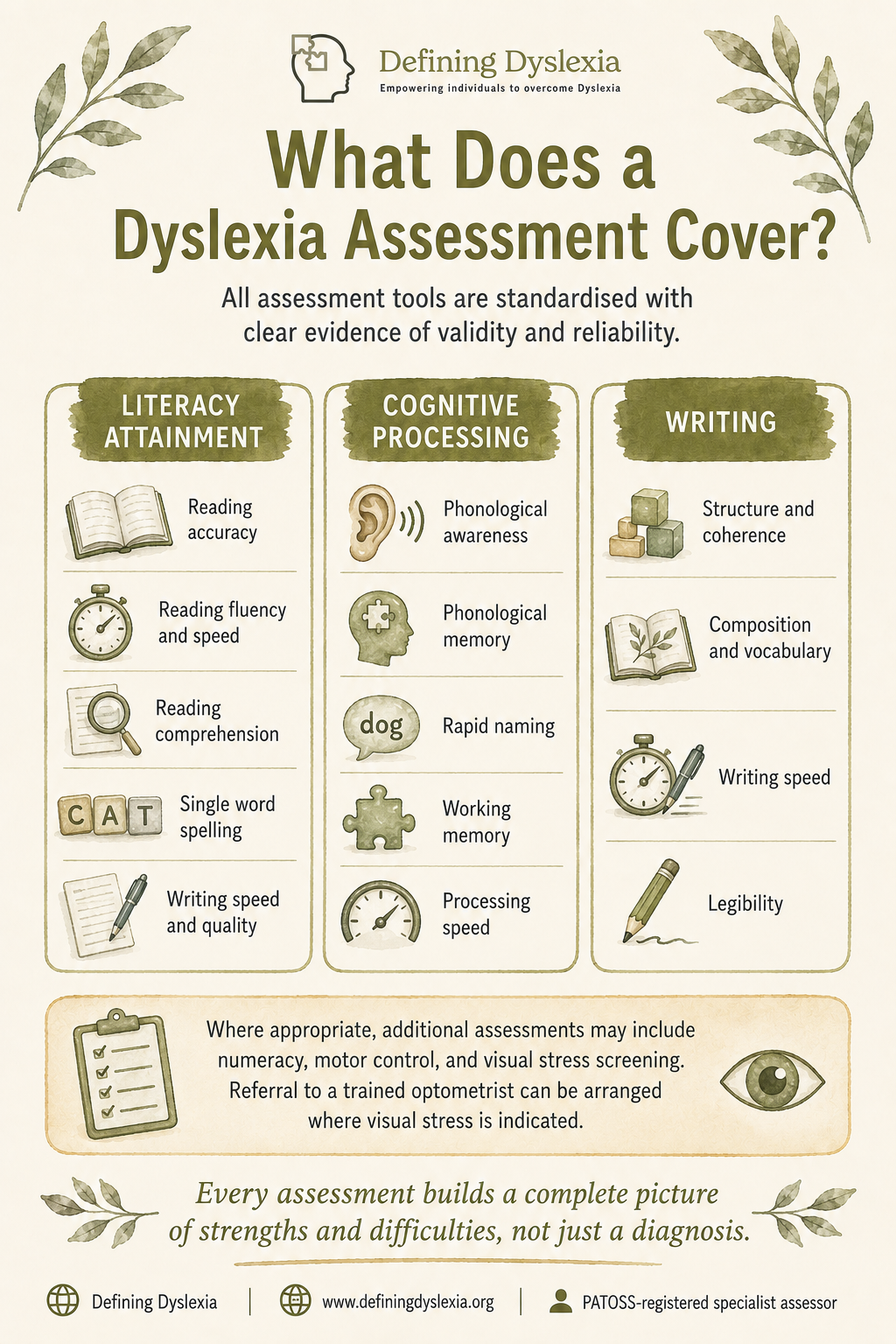
What Does The Assessment Cover?
All assessment tools are standardised, with clear evidence of validity and reliability.
Literacy attainment covers reading accuracy, reading fluency, reading speed, reading comprehension, single word spelling, and writing speed.
Cognitive processing covers phonological awareness, phonological memory, rapid naming, working memory, and processing speed.
Writing is assessed for structure, coherence, composition, speed, and legibility where relevant.
Where appropriate, additional assessments may be carried out in areas such as numeracy, motor control, or visual stress. If visual stress is indicated, referral to a trained optometrist can be arranged.
About Your Assessor
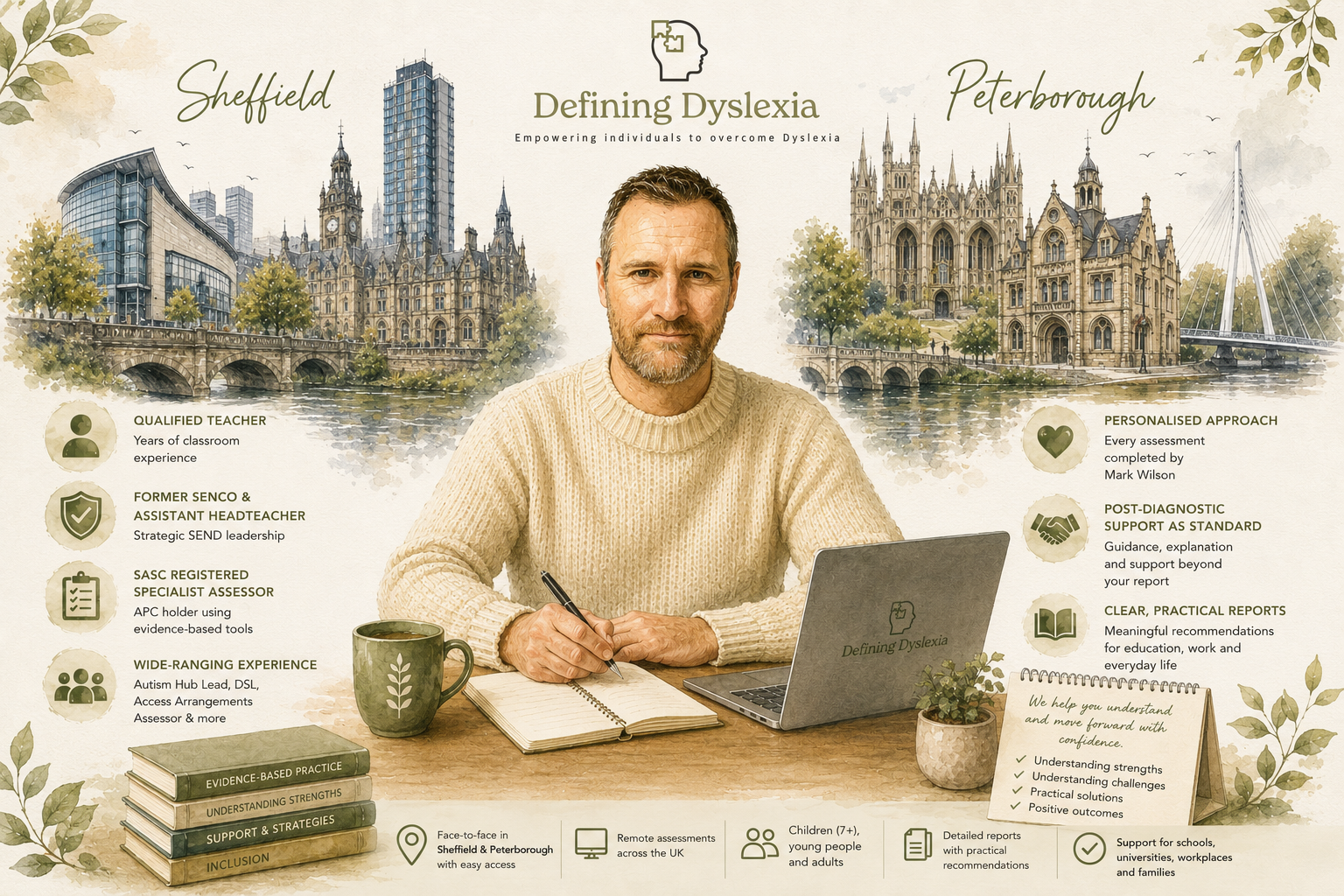
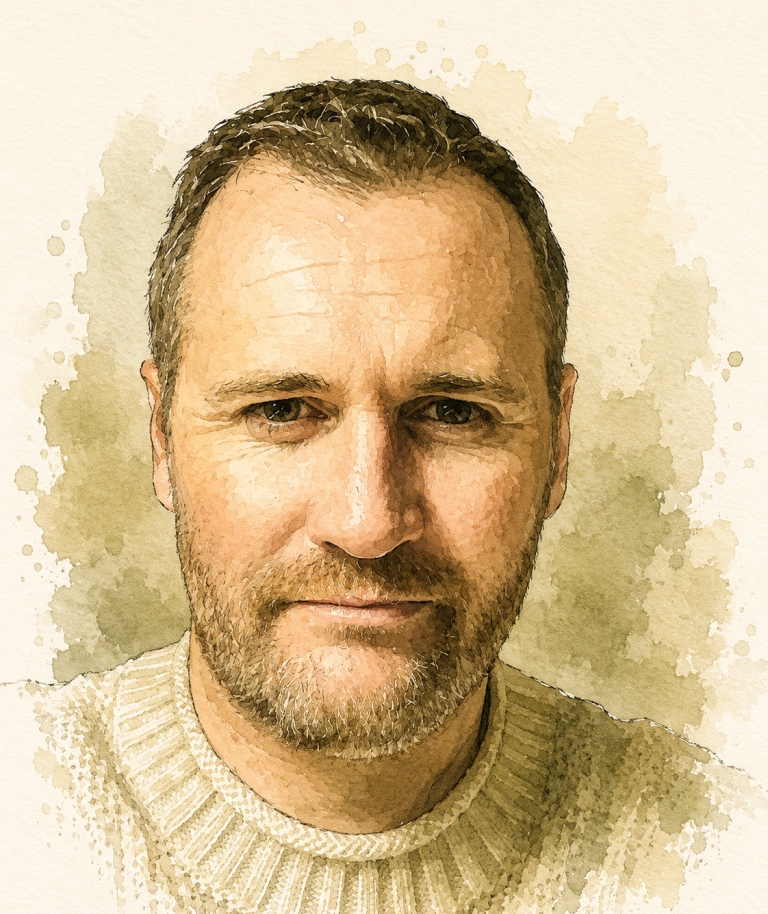
Every Defining Dyslexia assessment is carried out by Mark, a PATOSS-registered specialist assessor with fifteen years of experience supporting children, young people, and adults with dyslexia and other learning differences. Mark holds an APC and works to the standards set by SASC, the body that governs SpLD assessment quality across the UK. Mark's background as a former SENCo means he understands the school system from the inside, and brings that knowledge to every assessment and report he writes.
E-mail: Mark@definingdyslexia.org
We operate virtually across the UK, providing accessible support wherever you are. For in-person appointments, we serve Sheffield, Peterborough, and the surrounding area. Contact us to learn more!