What Does a Dyslexia Assessment Report Actually Look Like?
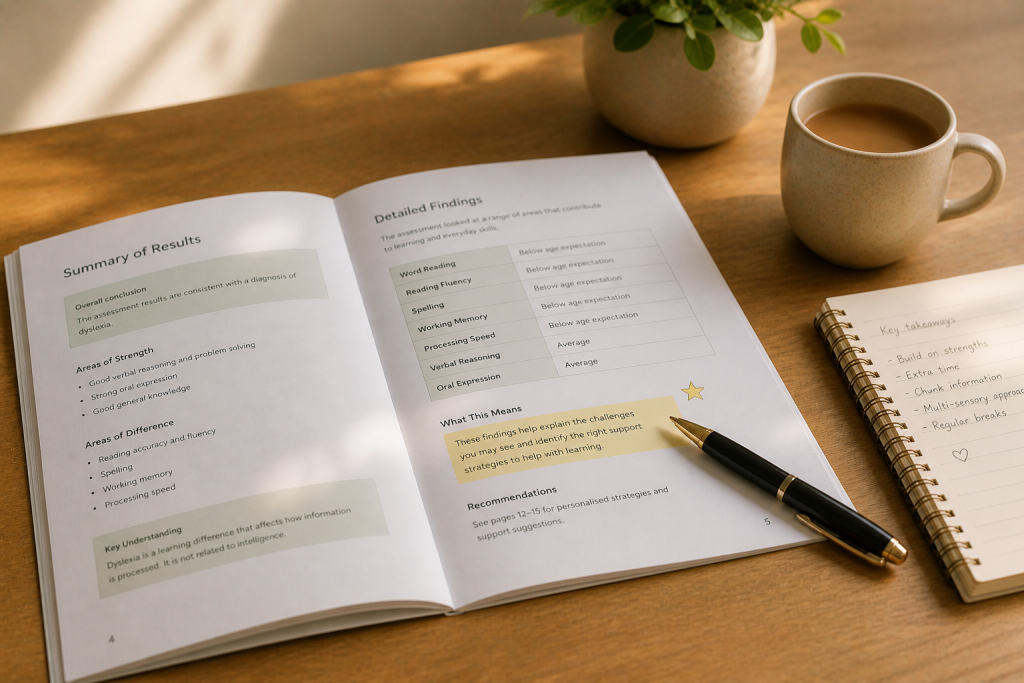
After a dyslexia assessment, you will receive a written report. For many families and adults, this is the document they have been working towards — and it can feel like a lot to take in when it arrives.
Understanding what a good report contains, and how to use it, is just as important as the assessment itself.
What Does a Dyslexia Assessment Report Include?
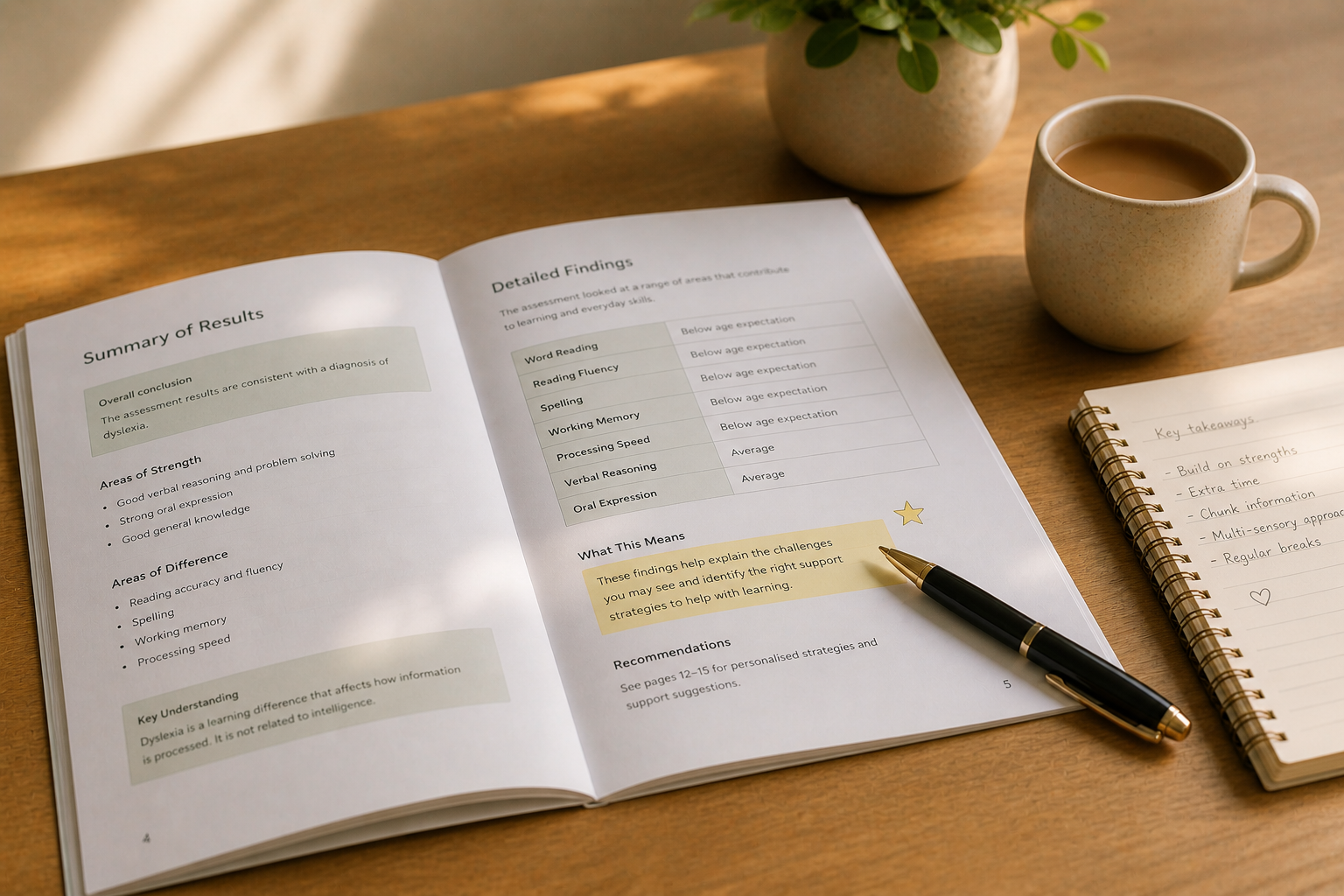
A thorough dyslexia assessment report will typically cover the following areas.
Background information. The report will open with a summary of the relevant background — developmental history, educational experience, any previous assessments or concerns, and the specific difficulties that led to the assessment being sought. This contextualises everything that follows.
Assessment findings. The core of the report sets out the results of the tasks carried out during the assessment. This includes scores across reading, spelling, phonological processing, working memory, and processing speed. A good report explains what each score means in plain language — not just the number, but what it tells us about how that person learns.
A clear conclusion. The report will state clearly whether the assessment findings are consistent with a diagnosis of dyslexia. If other difficulties have been identified — or if indicators of co-occurring conditions such as ADHD or dyspraxia are present — these will be noted, along with recommendations for any further assessment where appropriate.
Practical recommendations. This is one of the most important sections of any report. Good recommendations are specific, actionable, and tailored to the individual. They might cover classroom strategies, exam access arrangements, assistive technology, specialist tuition, or onward referrals. Additionally, they should be written in language that teachers, SENCos, universities, and employers can act on directly.
What Do the Scores Mean?
Scores in a dyslexia assessment report are typically presented as standardised scores — also known as standard scores — which allow an individual's performance to be compared to others of the same age. A score of 100 represents the population average. Scores above or below this indicate performance that is above or below what would typically be expected.
A good report will not simply list scores — it will explain what they mean in context. For example, a low score on a phonological processing task, alongside average scores in other areas, tells a very different story from a pattern of low scores across multiple areas. The assessor's job is to interpret that pattern and explain what it means for the individual.
How Long Is a Dyslexia Assessment Report?
Reports vary in length, but a thorough dyslexia assessment report is typically between fifteen and thirty pages. Length alone is not a measure of quality — what matters is that the report is clear, well-evidenced, and genuinely useful to the people who will read and act on it.
Who Can the Report Be Shared With?
A dyslexia assessment report can be shared with anyone who needs it — schools, colleges, universities, employers, and exam boards. It is your document and you decide who sees it.
Additionally, a report produced by a qualified and registered assessor is valid for life. It does not need to be updated or renewed, which means it can continue to open doors across education and employment for as long as it is needed.
What If the Report Is Hard to Understand?
A well-written report should be accessible to a non-specialist reader. However, assessment reports do contain technical terminology, and it is entirely reasonable to have questions after reading it.
At Defining Dyslexia, every assessment is followed by a conversation to discuss the findings — making sure that families and adults leave with a clear understanding of what the report says and what to do next. Additionally, if questions arise after the report has been received, I am always happy to discuss them.
What Should You Do With the Report?
Once you have received the report, there are some clear next steps worth taking.
Share it with your child's school as soon as possible and request a meeting to discuss how the recommendations will be implemented. If exam access arrangements are relevant, the SENCo will need the report to begin that process.
For university students, share the report with the institution's disability services team. Additionally, if you are applying for DSA, the report will form a central part of that application.
For adults in employment, the report provides the evidence-based basis for requesting reasonable adjustments under the Equality Act 2010.
A Final Word
A dyslexia assessment report is not just a piece of paper confirming a diagnosis. It is a detailed, evidenced account of how someone thinks and learns — one that can inform support, open doors, and provide clarity that lasts a lifetime. Additionally, for many families and adults, it is the first time anyone has looked that carefully and thoroughly at their individual profile.
That is worth taking seriously — and worth reading carefully.
At Defining Dyslexia, every report is written to be clear, thorough, and immediately useful — to the individual, their family, and the professionals working with them. Face-to-face appointments are available across Sheffield and South Yorkshire and across Peterborough and Cambridgeshire, with remote assessments available nationwide.
If any of this sounds familiar, it's worth getting in touch. Sometimes the most important thing is simply having someone take the whole picture seriously.