
Preparing for a Successful Start to Secondary School
Empowering Families on the Journey
At Defining Dyslexia we know the move to secondary school is a significant step, bringing new subjects, greater independence, and increased reading and writing demands. For some children, these changes simply represent an exciting new challenge. For others, they can highlight underlying literacy difficulties that may have gone unnoticed during primary school.
At Defining Dyslexia, we believe that understanding how a child learns is just as important as understanding what they achieve. Throughout this guide, we’ll explain why some bright children continue to struggle with reading and spelling, why these difficulties often become more apparent in Year 7, and how a diagnostic assessment can help families and schools provide the right support from the very beginning.
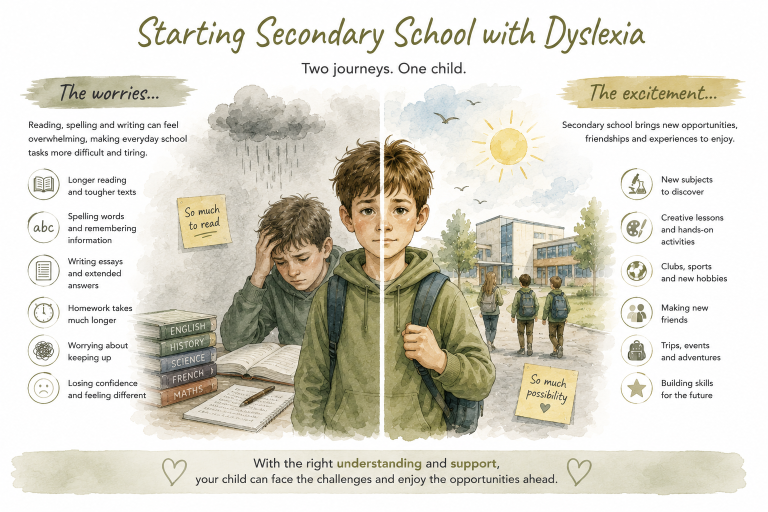
Dyslexia affects around 10% of the population and often goes unnoticed in children who compensate using their intelligence, vocabulary, and reasoning skills.
Helping your child start Year 7 with confidence.
What Changes When Children Start Secondary School?
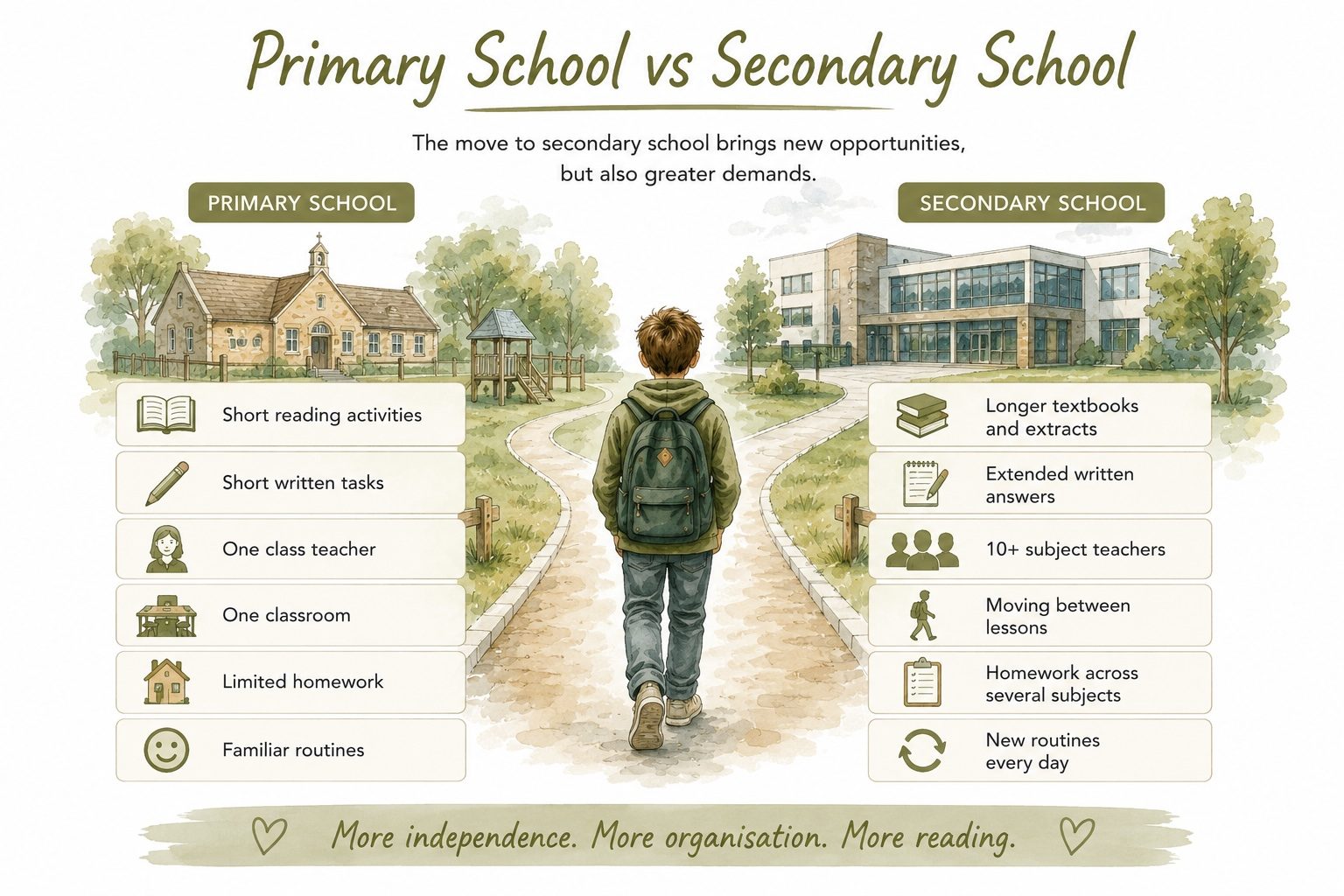
Starting secondary school brings exciting opportunities, but it also introduces much greater academic demands.
Most children look forward to Year 7. New subjects, specialist teachers, clubs, friendships, and greater independence can make the transition an exciting milestone.
However, alongside these opportunities comes a significant increase in reading, writing, organisation, and independent learning. Children are expected to process more information, remember more instructions, and complete longer pieces of work across a wider range of subjects.
For children with underlying literacy difficulties, these increased demands can make challenges that were previously manageable become much more noticeable.
Secondary school doesn’t cause dyslexia. It simply asks children to rely much more heavily on the very skills that dyslexia can affect.

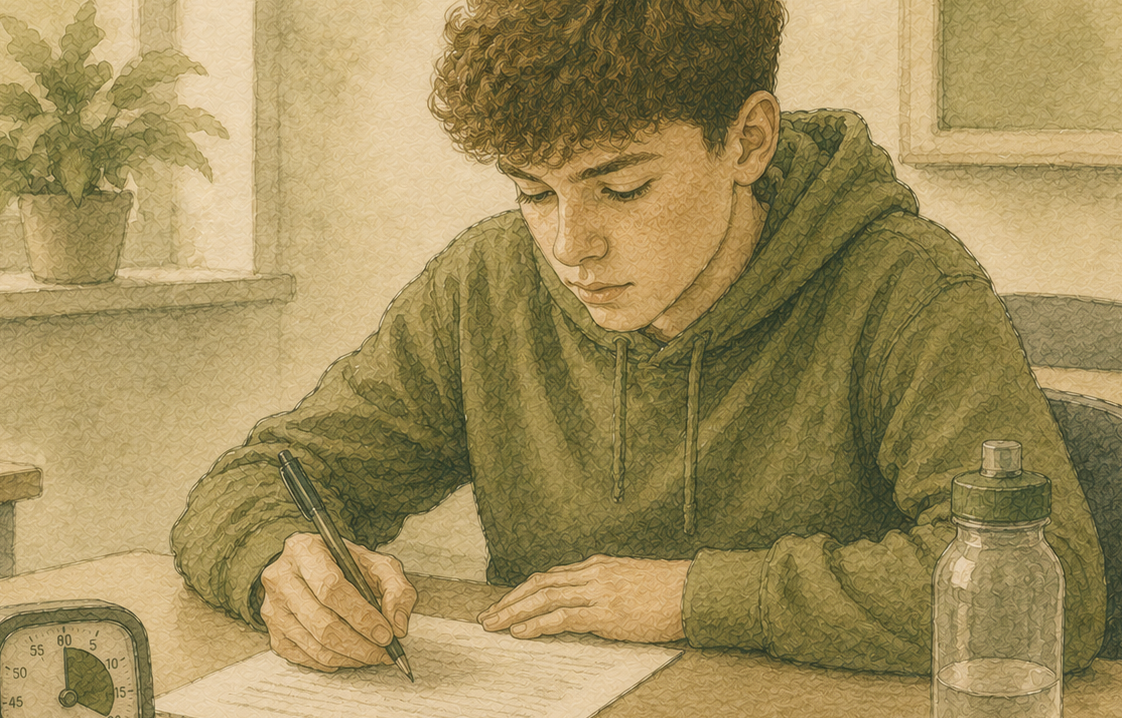
Why Can Secondary School Highlight Dyslexia?
Many children with dyslexia work incredibly hard throughout primary school. They develop ways of coping, using their strong vocabulary, reasoning skills, memory, or determination to keep up with their classmates.
As they move into secondary school, those strategies are often no longer enough on their own.
Lessons move more quickly, reading becomes more demanding, homework increases, and children are expected to organise themselves across multiple subjects. As a result, literacy difficulties that were previously hidden may become much more apparent.
This is one reason why some children are only identified with dyslexia during Year 7 or even later.
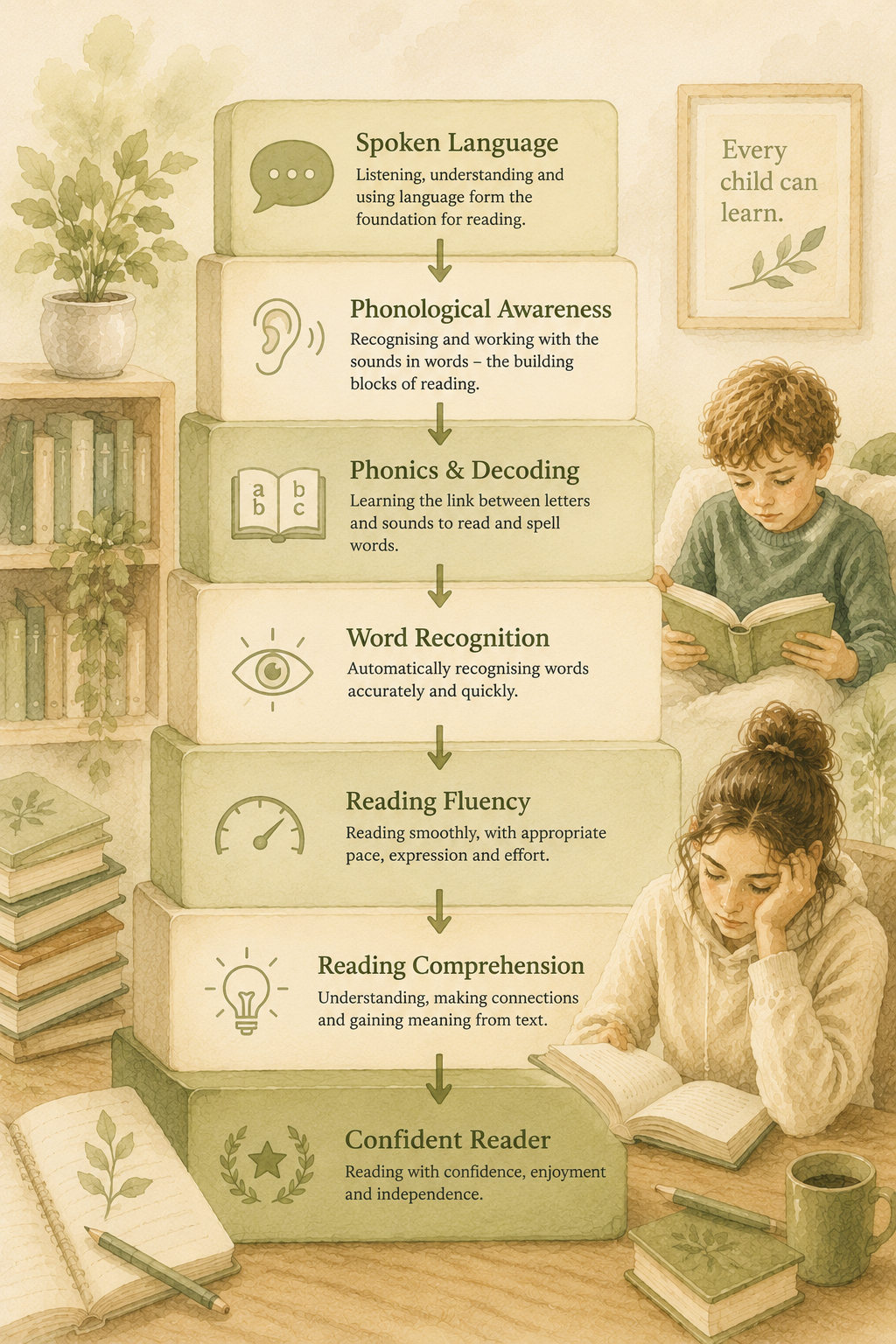
Reading depends on a series of interconnected skills developing efficiently. A difficulty in one area can affect the speed and effort required to read, even when a child is bright and understands language extremely well.
How does reading actually work?
How does reading actually work?
Reading feels effortless for fluent readers, but it is actually one of the most complex skills the brain has to learn.
Unlike spoken language, reading does not develop naturally. It relies on a number of different skills becoming automatic over time. When one or more of these skills develops less efficiently, reading can become slower, more effortful, and increasingly tiring.
Understanding how reading develops helps explain why some bright children continue to struggle despite working incredibly hard.
1. Understanding the Simple View of Reading
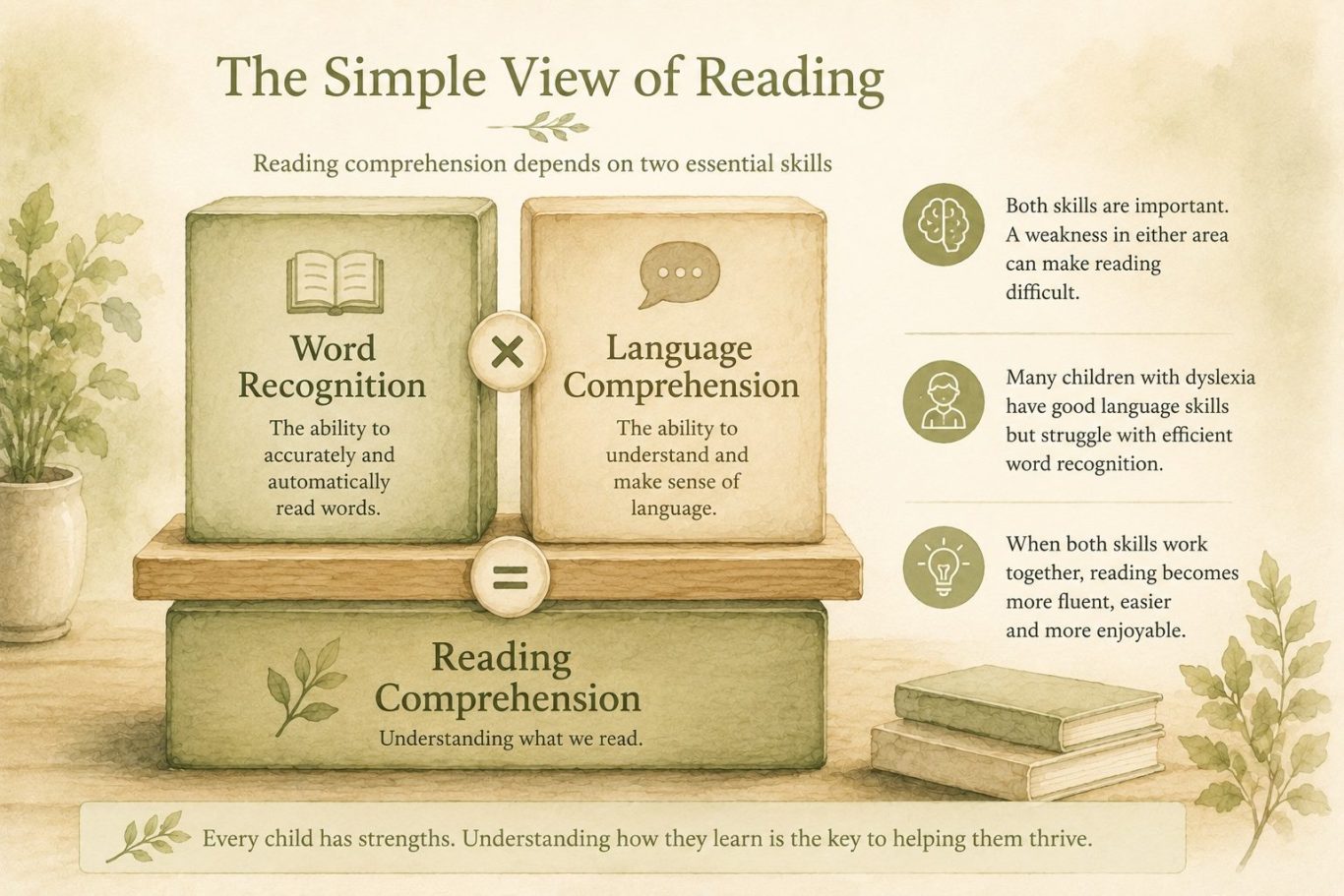
One of the most widely accepted models of reading is known as the Simple View of Reading.
It explains that reading comprehension depends on two broad skills:
Reading Comprehension = Word Recognition × Language Comprehension
This means children need to be able to recognise written words efficiently and understand language.
A weakness in either area can affect reading, while strengths in one area may partly compensate for difficulties in another.
For many children with dyslexia, language comprehension is good, but efficient word recognition develops much more slowly.
2. Reading starts with spoken language
Before children ever learn to read, they develop spoken language.
This includes:
- listening
- understanding language
- learning new vocabulary
- recognising speech sounds
- remembering verbal information
Strong spoken language provides an important foundation for reading, although children can still experience reading difficulties even when they are articulate and have an excellent vocabulary.
3. Decoding
The next stage is learning that letters represent sounds.
Children gradually learn to:
- recognise letters
- blend sounds together
- break words apart
- read unfamiliar words
This process is known as decoding.
At first it is slow and deliberate, but with practice it becomes increasingly automatic.
4. Reading Fluency
Once decoding becomes automatic, children begin to read more fluently.
Fluent readers:
- recognise familiar words instantly
- read smoothly
- use expression
- spend very little mental effort identifying words
Instead, their brain can focus on understanding what they are reading.
5. Reading Comprehension
Comprehension is the purpose of reading.
It involves:
- understanding vocabulary
- making connections
- drawing conclusions
- remembering information
- understanding the author’s meaning
Some children understand stories extremely well when someone else reads to them but struggle when reading independently because so much effort is spent recognising the words.
Questions Parents Often Ask Before Year 7
💭 Should I have my child assessed before they start secondary school?
Many parents choose to arrange an assessment during Year 6 so that they understand their child’s learning profile before the move to secondary school.
If dyslexia is identified, the report and recommendations can be shared with the new school’s SENCO, helping staff understand your child’s strengths and support needs from the beginning.
01
💭 Is Year 6 a good time for a dyslexia assessment?
Yes. By Year 6, children have received several years of reading and writing instruction, allowing a specialist assessor to build a clear picture of their literacy skills.
An assessment before secondary school also gives families time to understand the findings and discuss recommendations before the new academic year begins.
02
💭 Can the new
secondary school use the report?
Yes. Many parents choose to share the report with the receiving school’s SENCO and teaching staff.
A diagnostic report helps explain how your child learns and provides practical recommendations that can be considered as part of their support in school.
03
💭 Will a dyslexia
diagnosis automatically give my child extra time in exams?
No. A diagnostic assessment does not automatically result in exam access arrangements. Schools must follow the Joint Council for Qualifications (JCQ) regulations and gather evidence that any arrangements reflect the student’s normal way of working.
However, an assessment can provide valuable information about your child’s learning profile that may support future discussions with the school.
04
💭 What if my child doesn’t have dyslexia?
A comprehensive assessment is designed to understand how your child learns, not simply whether they meet the criteria for dyslexia.
Many families find the assessment valuable because it identifies strengths alongside any areas of difficulty and provides personalised recommendations to support learning, whatever the outcome.
05
💭 My child is doing well at primary school. Should I still consider an assessment?
Some children achieve good results by working much harder than their classmates or by using strong reasoning and language skills to compensate for literacy difficulties.
If reading, spelling, or writing continue to require significantly more effort than expected, understanding your child’s learning profile before secondary school can help ensure the right support is in place from the outset.
06
How much does an
assessment cost?
A full dyslexia assessment with Defining Dyslexia costs £495. This includes the assessment session and a comprehensive written report with practical recommendations. There are no hidden costs and no additional charges.
Assessments can be carried out in your home, at your child's school, or at a suitable venue local to you. Where a venue needs to be booked, a small additional fee may apply. This will always be discussed and agreed with you before anything is confirmed.
For adult assessments that include screening for co-occurring conditions such as ADHD or dyspraxia, a small additional fee also applies. This will be discussed with you at enquiry stage.
If you would like to talk through costs before booking, you are very welcome to get in touch.
What Does The Assessment Cover?
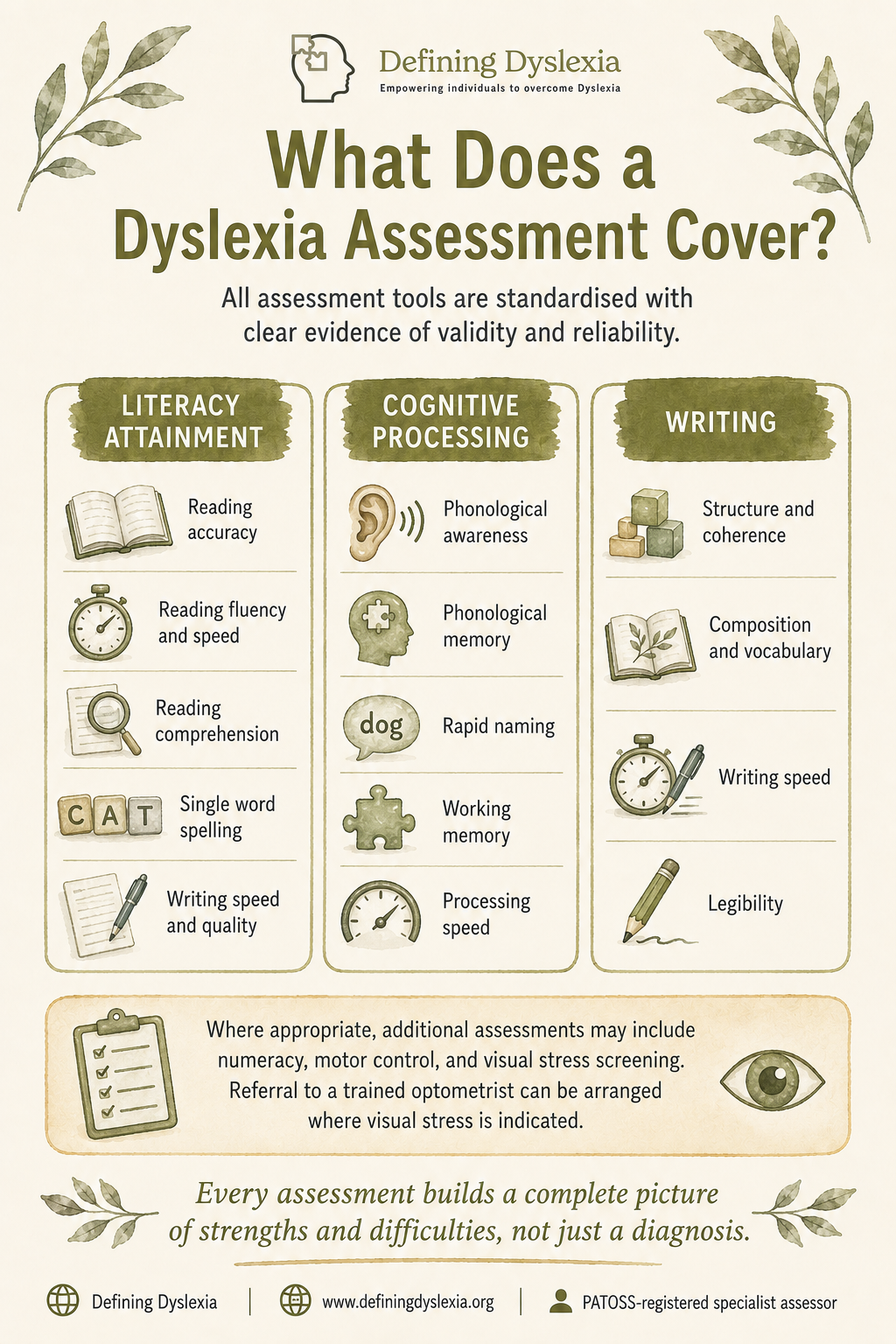
All assessment tools are standardised, with clear evidence of validity and reliability.
Literacy attainment covers reading accuracy, reading fluency, reading speed, reading comprehension, single word spelling, and writing speed.
Cognitive processing covers phonological awareness, phonological memory, rapid naming, working memory, and processing speed.
Writing is assessed for structure, coherence, composition, speed, and legibility where relevant.
Where appropriate, additional assessments may be carried out in areas such as numeracy, motor control, or visual stress. If visual stress is indicated, referral to a trained optometrist can be arranged.
What You Can Expect from a Defining Dyslexia Assessment?
Every assessment is built around you. Here is what makes Defining Dyslexia the right choice for families and individuals.

WHO IT IS FOR?
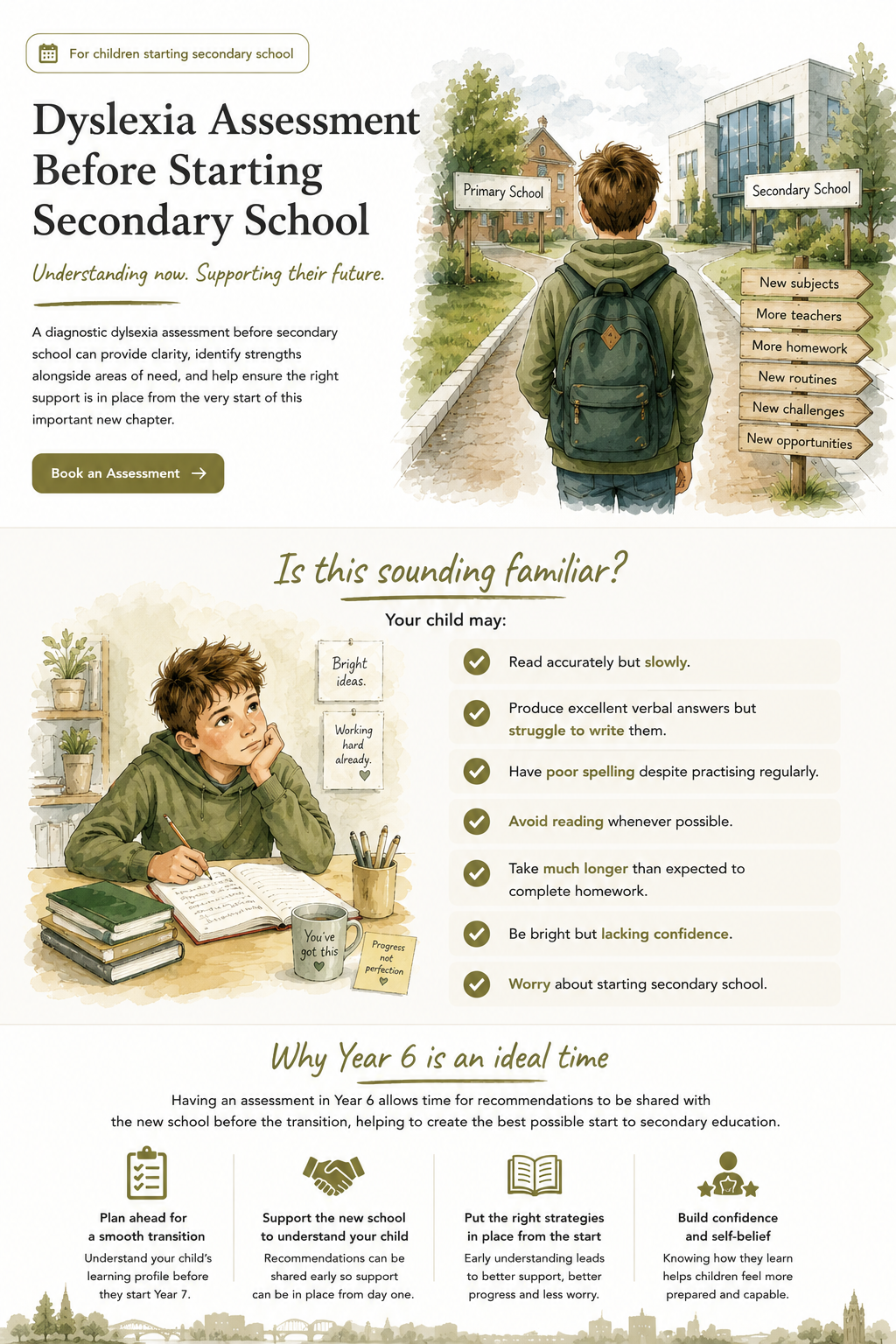
This guide is designed for parents of children approaching the move to secondary school who continue to find reading, spelling, or writing more difficult than expected.
Whether your child has always worked exceptionally hard or you’re simply looking for reassurance before the transition, this page explains how an assessment can help.

WHAT THE ASSESSMENT INVOLVES?
Starting secondary school brings longer reading tasks, increased independence, more homework, and higher academic expectations.
A diagnostic assessment during Year 6 provides time to understand your child’s learning profile and, if you wish, share recommendations with the new school before they start Year 7.

WHY CHOOSE DEFINING DYSLEXIA?
Assessments are carried out by a qualified specialist teacher and former SENCO with extensive experience supporting children through key educational transitions.
Every report is personalised, practical, and designed to help schools and families understand how a child learns, with post-diagnostic support included as standard.

About Your Assessor
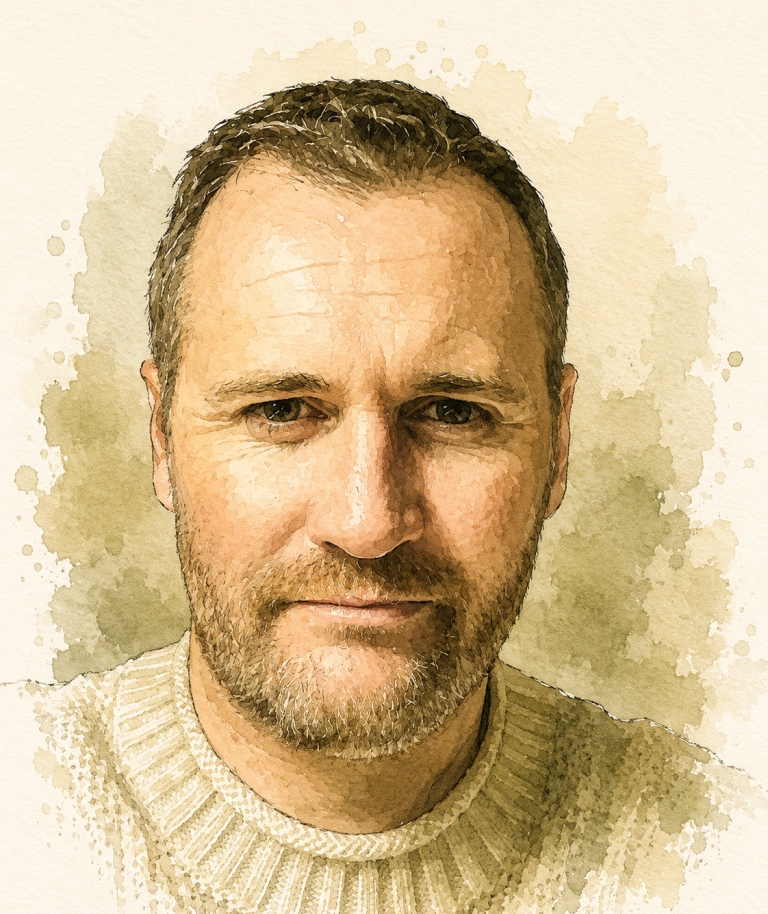
Every Defining Dyslexia assessment is carried out by Mark, a PATOSS-registered specialist assessor with fifteen years of experience supporting children, young people, and adults with dyslexia and other learning differences. Mark holds an APC and works to the standards set by SASC, the body that governs SpLD assessment quality across the UK. Mark's background as a former SENCo means he understands the school system from the inside, and brings that knowledge to every assessment and report he writes.
E-mail: Mark@definingdyslexia.org
We operate virtually across the UK, providing accessible support wherever you are. For in-person appointments, we serve Sheffield, Peterborough, and the surrounding area. Contact us to learn more!