What Do Dyslexia Assessment Scores Actually Mean?
When parents receive a dyslexia assessment report, one of the first things they notice is the numbers. There are scores for reading, spelling, memory, processing speed, and more, and it isn't always obvious what any of them mean. This post explains the scoring system used in professional assessments and what different results actually tell you about your child.
What is a standardised score?
A standardised score is a way of comparing your child's performance to other children of the same age. Rather than just saying how many questions they got right, it places their result on a scale that accounts for what is typical for their age group. Most standardised tests used in dyslexia assessments use a scale where the average score is 100.
Reading the bell curve
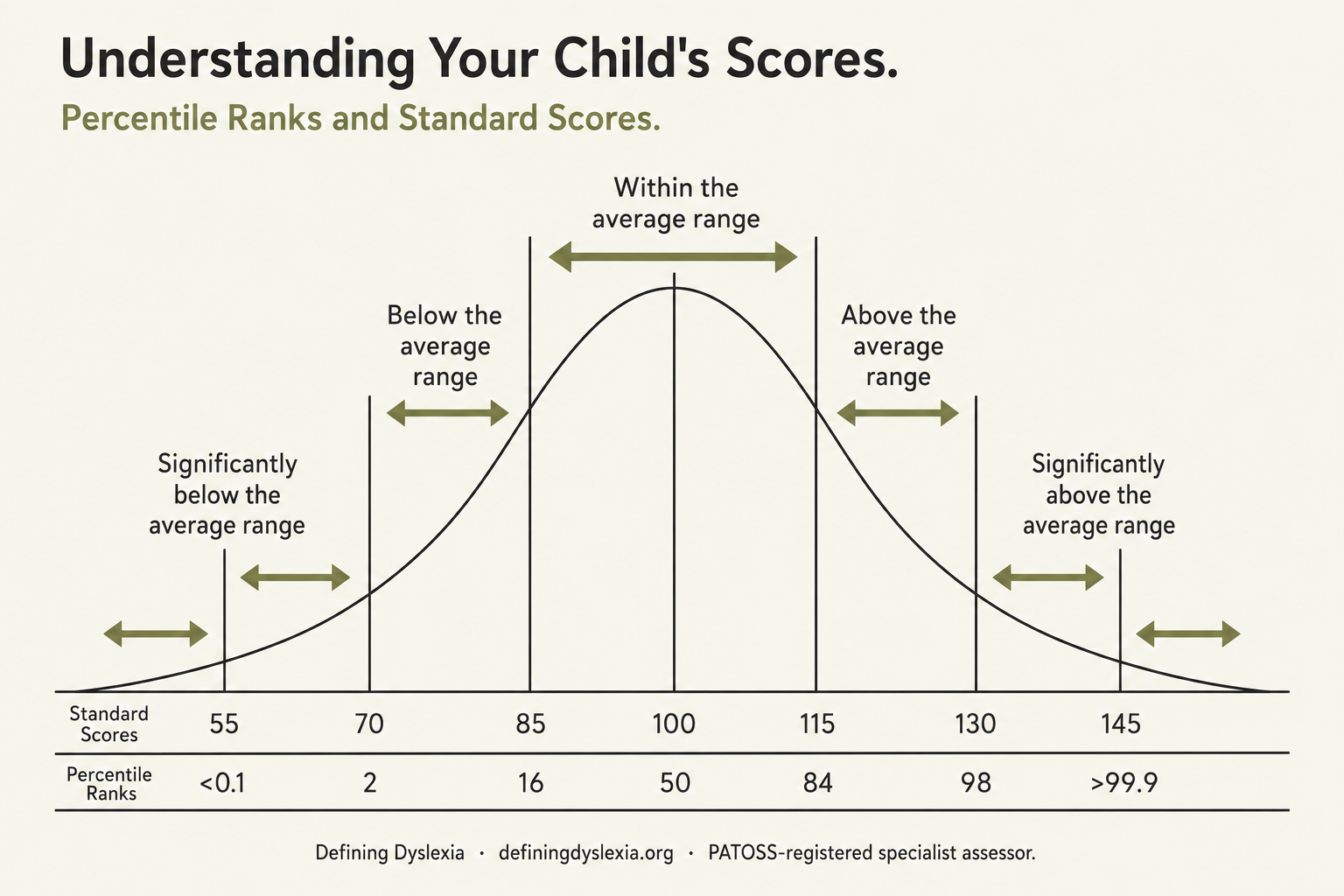
You may have seen a bell curve diagram in your child's report or heard the term used by an assessor. It describes how scores are distributed across the population, and it's one of the most useful tools for understanding what a result really means.
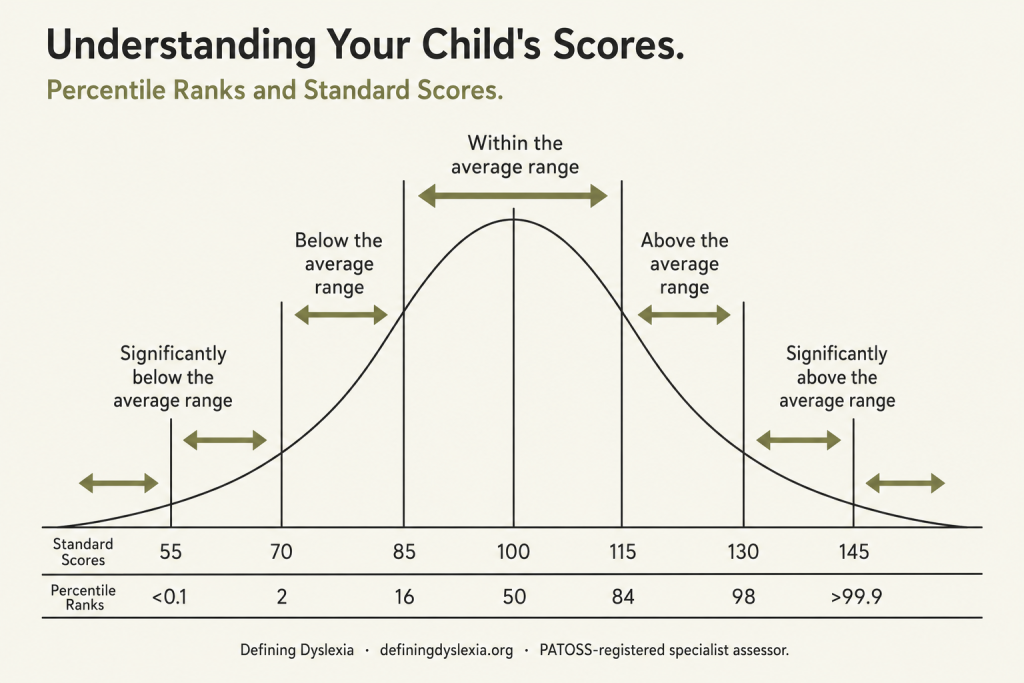
The diagram above shows how scores fall across that scale. Most children score somewhere in the middle, between 85 and 115, which covers the average range. Scores below 85 start to indicate increasing difficulty relative to peers, and scores above 115 indicate relative strength.
What the score ranges mean?
Here is a straightforward breakdown of how scores are typically interpreted in a professional assessment report.
A score of 131 or above sits in the well above-average range, indicating a significant strength in that area. Scores between 116 and 130 are above-average, and scores between 111 and 115 are described as high average. The mid-average range covers scores between 90 and 110, which is where most of the population falls.
Below that, scores between 85 and 89 are described as low average. A score between 70 and 84 sits in the below-average range and typically signals a meaningful area of difficulty. Scores of 69 or below fall in the well below-average range and represent a significant difference from what would be expected for a child of that age.
Why do assessments test so many different things?
Dyslexia affects a cluster of skills rather than just one. A thorough assessment will typically look at reading accuracy, reading fluency, spelling, phonological awareness, phonological memory, and processing speed. Some assessments also include measures of working memory and expressive writing. Each area generates its own score, and the pattern across all of them is what helps an assessor build a full picture.
This is important because a child might perform within the average range on a single reading task whilst showing significant difficulty in phonological processing or memory, and it is often that underlying pattern that points most clearly to dyslexia.
What a low score doesn't mean
A below-average score in one area does not define your child's intelligence or their potential. Standardised assessments measure specific, narrow skills at a point in time. Many highly capable individuals show significant difficulty in areas like phonological processing or processing speed whilst demonstrating real strengths elsewhere, in reasoning, creativity, verbal expression, or problem-solving. A good assessment report will highlight both.
What happens next?
Understanding the scores is a starting point, not an end point. The assessor's conclusions and recommendations section of the report translates those numbers into practical guidance, for school, for home, and in some cases for access arrangements in exams. If anything in the report feels unclear, you are always entitled to ask for an explanation.
Additionally, if your child's school has received a copy of the report and you are unsure how they are acting on it, a meeting with the SENCO is a reasonable and worthwhile next step.
At Defining Dyslexia, we always make time to talk parents through findings at the end of an assessment. A number on a page is only useful if you know what to do with it.
How Defining Dyslexia can help
At Defining Dyslexia, we offer full diagnostic SpLD assessments for children and adults across Sheffield, South Yorkshire, and Peterborough, with remote assessments available across the UK. Every assessment includes time at the end to talk through findings together, so you leave with a clear understanding of the results, not just a document to decipher on your own.
If you have questions about your child's scores, or you are wondering whether an assessment might be the right next step, we are happy to have an initial conversation. There is no obligation, and sometimes a short chat is all it takes to feel clearer about where to go next.
You can get in touch via the contact page at https://www.definingdyslexia.org/contact-us/