What's behind the price tag? Understanding the real cost of a dyslexia assessment.
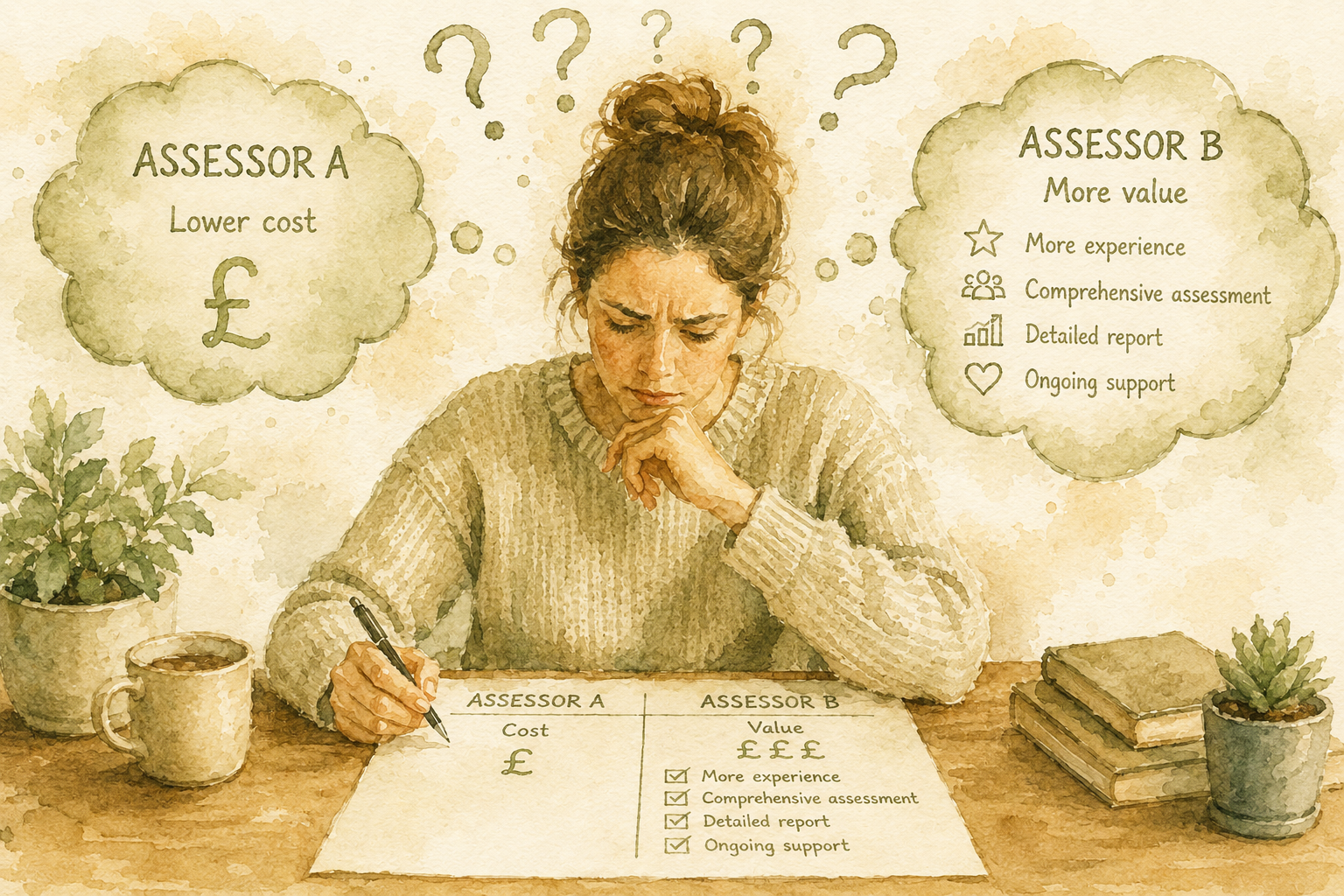
If you have started looking into getting your child assessed, you may have noticed that prices vary enormously, sometimes by hundreds of pounds. That can feel confusing, and even a little unsettling. Here, we want to help you understand what shapes the cost of an assessment, so you can make a more confident decision.
It starts with the assessor's qualifications
One of the most significant factors in the cost of an assessment is who is carrying it out. A specialist teacher assessor holds a Level 7 qualification in assessment, alongside years of classroom and SpLD experience. An educational psychologist has trained to doctoral level. Both routes carry a professional cost, and rightly so.
To assess for dyslexia, a practitioner must hold the Assessment Practising Certificate, known as the APC. This is a rigorous qualification, and it ensures they are trained to administer and interpret standardised assessments accurately. Importantly, the APC must be renewed regularly. Holding it is not simply a case of qualifying once and moving on. Assessors are required to engage in ongoing professional development to maintain their standing, and to stay current with the latest research, tools, and best practice.
Good professional development is not cheap. Specialist training, conferences, and supervision all carry a cost. That investment is reflected in the fees of assessors who take their development seriously. Additionally, it is a meaningful indicator of quality. An assessor committed to their own learning is one committed to staying at the front of their field, which ultimately benefits your child.
What type of assessment is needed?
Not all assessments are the same, and the type your child needs will shape the cost. A focused diagnostic assessment for dyslexia and a full educational psychology assessment are different in scale. For most dyslexia purposes, a specialist teacher assessment is widely accepted, and it offers excellent value. Schools, exam boards, and universities recognise these reports for access arrangements and for Disabled Students' Allowance.
There are some situations where a wider educational psychology assessment is needed, such as certain parts of an EHCP process. It helps to be clear about what your child specifically needs, as that will help you feel confident about the right route, and the investment involved.
Time and complexity — more than just the session
It is easy to assume you are paying for a single appointment, but the reality is quite different. Before the assessment, your assessor will review background information, school reports, and any previous assessments. The session itself typically lasts two to three hours. A series of carefully standardised tests are administered at a considered pace, to ensure accuracy, and to keep your child comfortable throughout.
After the session, the assessor will score the tests, analyse the results, and interpret what they mean in the context of your child as a whole person. Additionally, they will identify patterns across different areas of learning, and begin to draw meaningful conclusions. This process takes many hours, before a single word of the report is written.
The report itself takes considerable time
A high-quality report is not a brief summary. It is a detailed professional document. It will outline your child's profile across multiple areas, explain what the scores mean, and make specific, practical recommendations for school, home, and any wider support.
Writing clearly and precisely about a child's needs takes real skill and significant time. The report must make sense to teachers, to SEN coordinators, and to other professionals. Many assessors spend as long writing the report as they do carrying out the assessment itself. This work is very much part of what you are investing in.
Look for the extras that come with the process
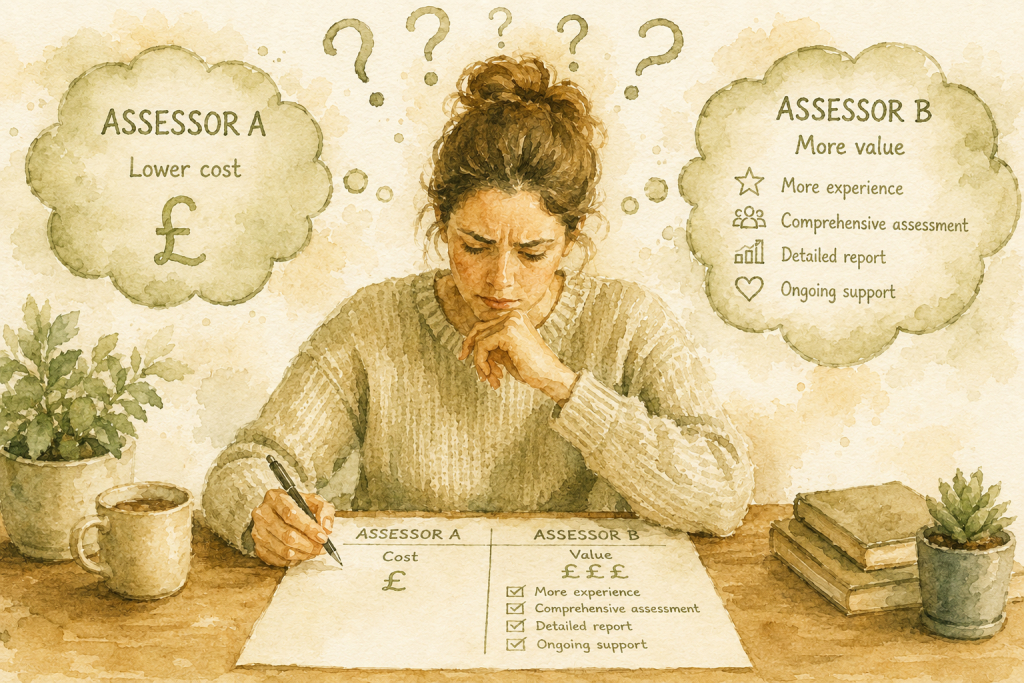
When comparing assessors, it is worth looking beyond the headline figure, and asking what else is included. The best practitioners offer considerably more than a session and a report. Some will hold a pre-assessment conversation, to understand your concerns and gather background. Others will include a feedback session after the report, walking you through the findings in plain language.
Additionally, some will liaise directly with your child's school, provide a parent summary, or offer ongoing support as recommendations are put into practice. These extras may not always appear on a price list, yet they represent real time and expertise. An assessor who provides this kind of wraparound support often offers far greater value than one with a lower headline fee and nothing more.
It is always worth asking what the process looks like from start to finish, and what support you will receive along the way.
Where you live can also make a difference
It is an honest reality that location affects assessment costs across the UK. Assessors based in London and the South East typically charge more, reflecting higher overheads in those areas. Some rural or less served regions have fewer available assessors, which can also affect pricing through limited supply.
If cost is a significant concern, it may be worth exploring assessors who work remotely, or who cover a wider area. Some assessors can also offer payment plans, so it is always reasonable to ask.
NHS versus private provision
Dyslexia assessments are not routinely offered through the NHS, and most families will find that private assessment is their primary route to a diagnosis. Whilst some NHS trusts do offer support in this area, provision is inconsistent and waiting times can still be considerable.
Additionally, a privately commissioned SpLD report carries full professional weight. Schools, local authorities, and SEND tribunals all recognise privately produced assessments, provided they have been carried out by a suitably qualified professional.
A note on value. We understand that the cost of an assessment can feel like a significant outlay, particularly when families are already navigating a stressful and uncertain time. What a thorough, well-written assessment offers is not just a diagnosis (it is clarity, direction, and a professional voice advocating for your child). Many families describe it as one of the most useful investments they have made in their child's education.
What to ask before you book?
When comparing assessors, it is entirely reasonable to ask what is included in the fee. A transparent assessor will be happy to explain whether the cost covers the session, the report, any follow-up conversation, and what additional support forms part of the process. Additionally, it is worth asking about their qualifications, their experience with children of your child's age, and the expected turnaround time for the report.
You deserve to feel confident in who you are working with — and a good assessor will welcome those questions.
How Defining Dyslexia can help
At Defining Dyslexia, we offer full diagnostic SpLD assessments for children and adults across Sheffield, South Yorkshire, and Peterborough, with remote assessments available across the UK. Every assessment includes time at the end to talk through the findings together, so you leave with a clear understanding of the results, not just a document to decipher on your own.
If you have questions about your child's scores, or you are wondering whether an assessment might be the right next step, we are happy to have an initial conversation. There is no obligation, and sometimes a short chat is all it takes to feel clearer about where to go next.
How Defining Dyslexia can help
At Defining Dyslexia, we offer full diagnostic SpLD assessments for children and adults across Sheffield, South Yorkshire, and Peterborough, with remote assessments available across the UK. Every assessment includes time at the end to talk through findings together, so you leave with a clear understanding of the results, not just a document to decipher on your own.
If you have questions about your child's scores, or you are wondering whether an assessment might be the right next step, we are happy to have an initial conversation. There is no obligation, and sometimes a short chat is all it takes to feel clearer about where to go next.
You can get in touch via the contact page at https://www.definingdyslexia.org/contact-us/