
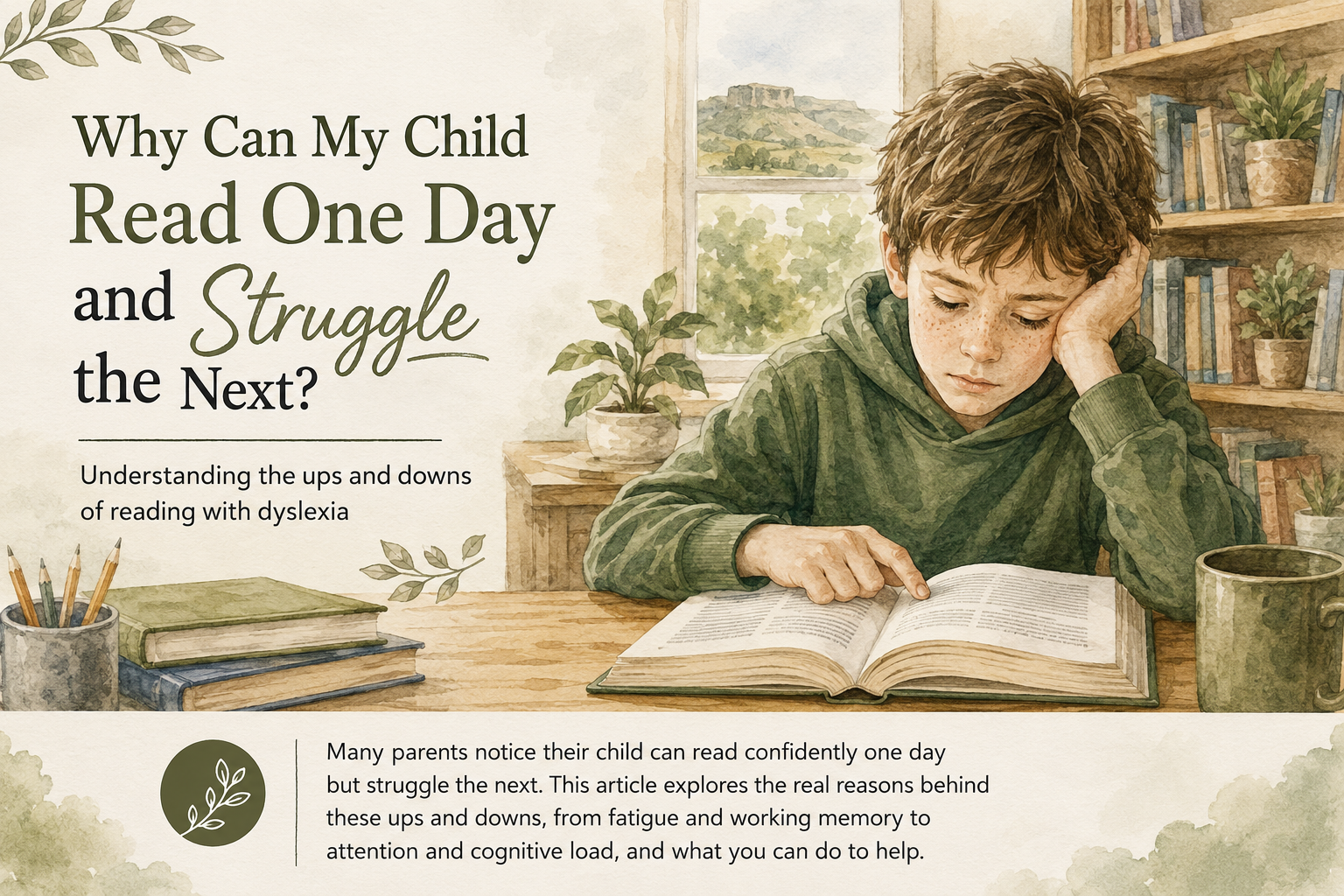
Why Can My Child Read One Day and Struggle the Next?
It can be confusing when a child reads a passage confidently one day, yet struggles with similar words or text the next. Parents may wonder whether their child is rushing, not concentrating, or simply not trying hard enough. However, inconsistent reading is common when literacy skills are not yet automatic, particularly for children with dyslexia or related processing difficulties.
Reading is not one single skill. It relies on attention, memory, language, processing speed, word recognition, and the ability to manage several demands at the same time. When one of these areas is under strain, performance can vary considerably.
Reading ability is not always consistent
A child may recognise a familiar word quickly in one context, then hesitate over the same word later. This does not necessarily mean they have forgotten it. Instead, the conditions around the task may have changed.
They may be more tired, distracted, anxious, or mentally overloaded. The text may also place greater demands on vocabulary, comprehension, or sentence structure. As a result, fewer mental resources are available for recognising and decoding words.
For children whose reading is not fully automatic, small changes in energy or concentration can have a noticeable effect.
Fatigue can make reading much harder
Reading can require significant effort for a child with dyslexia. While fluent readers recognise many words automatically, a child with weaker decoding or word-recognition skills may need to work through words more consciously.
This effort builds over time.
A child may therefore read more accurately at the beginning of the school day, but struggle later in the afternoon. Similarly, they may cope with a short passage yet become slower and less accurate during extended reading.
Signs of fatigue may include:
- losing their place;
- skipping words or lines;
- guessing words from the first letter;
- needing to reread sentences;
- becoming frustrated or avoiding the task.
This does not mean that the child is capable in the morning and incapable later. It means that sustained reading is using more mental energy than it would for a fluent reader.
Working memory affects reading
Working memory allows us to hold information in mind while using it. During reading, a child needs to remember the beginning of a sentence while processing the words that follow.
They may also need to hold sounds in mind while blending them together, remember instructions, and connect new information with what they have already read.
When working memory becomes overloaded, a child may:
- forget what a sentence was about;
- lose track of longer instructions;
- read individual words accurately but miss the overall meaning;
- struggle with longer or unfamiliar words;
- need to return to the beginning of a sentence.
This can make reading appear inconsistent. A child may manage well when sentences are short and familiar, but struggle when the language becomes more complex.
Processing speed can affect fluency
Processing speed refers to how efficiently a person takes in information and responds to it. A child may understand what they are reading, but need more time to recognise words, retrieve sounds, or organise a response.
When they are allowed to work at their own pace, they may read accurately. However, difficulties can become more noticeable when they feel rushed or need to keep up with others.
This is why a child may read a passage well at home, yet struggle when asked to read aloud unexpectedly in class. The added pressure can reduce fluency and increase errors.
Slower processing does not mean lower ability. It means that the child may need more time to access and show what they know.
Attention also plays a part
Reading requires sustained attention. A child must remain focused on the text, ignore distractions, track their place, and monitor whether what they are reading makes sense.
When attention fluctuates, reading performance may fluctuate too.
This may be particularly noticeable in children with ADHD or attention-related difficulties. However, attention can also reduce when a task is tiring, repetitive, difficult, or anxiety-provoking.
A child who appears distracted may actually be mentally overloaded. Avoidance can also develop when they expect reading to be difficult or embarrassing.
Cognitive load can become overwhelming
Cognitive load describes the amount of information the brain is managing at one time.
When reading, a child may need to:
- identify letters and sounds;
- blend sounds into words;
- recognise familiar words;
- remember punctuation;
- understand vocabulary;
- follow the meaning of the sentence;
- connect ideas across the passage.
For a fluent reader, many of these processes happen automatically. For a child with dyslexia, several may require conscious effort.
When too many demands build up, accuracy and understanding can reduce. This explains why a child may cope with simple text but struggle when the page contains unfamiliar vocabulary, dense paragraphs, or more complex ideas.
Familiarity can create misleading differences
Children often read familiar books, repeated texts, or favourite topics more confidently. This can sometimes give the impression that their reading difficulty has disappeared.
However, familiar material places fewer demands on decoding and comprehension. A child may remember parts of the text, predict words from context, or use their background knowledge to support meaning.
Their difficulties may become clearer when they meet:
- unfamiliar vocabulary;
- new spelling patterns;
- longer words;
- less predictable texts;
- subjects they know less about.
This is why reading should be considered across different tasks rather than judged from one successful piece of reading.
Emotional factors can affect performance
Confidence has a strong influence on reading.
A child who feels calm and supported may take their time and use helpful strategies. In contrast, a child who feels watched, rushed, or worried about making mistakes may begin guessing or refusing to read.
Repeated difficulty can also affect self-esteem. Some children begin to describe themselves as lazy or “bad at reading”, even when they are working extremely hard.
A supportive response is important. Rather than pointing out that they read the word correctly yesterday, it can help to acknowledge that reading feels more difficult today.
What parents and teachers can do
When reading performance varies, it is useful to look for patterns.
Consider whether the difficulty is greater:
- later in the day;
- after a busy or tiring period;
- when the child is reading aloud;
- during longer tasks;
- when vocabulary is unfamiliar;
- when instructions are given quickly;
- when the child feels under pressure.
Simple adjustments may help. These can include shorter reading periods, regular breaks, reduced pressure to read aloud, clear formatting, and extra time to process unfamiliar text.
It may also help to preview vocabulary before reading and allow the child to use a ruler or reading guide to track each line.
When should I consider an assessment?
Occasional variation in reading is normal. However, further investigation may be helpful when inconsistency sits alongside ongoing difficulties with:
- slow or effortful reading;
- inaccurate word recognition;
- guessing unfamiliar words;
- repeated rereading;
- poor spelling;
- difficulty remembering what has been read;
- avoiding reading tasks;
- becoming unusually tired or frustrated.
A diagnostic dyslexia assessment explores the underlying skills involved in reading. It looks beyond a single reading result and considers the wider pattern of strengths and difficulties.

A final word
A child who reads well one day and struggles the next is not necessarily being careless or uncooperative.
Their performance may reflect fatigue, working-memory demands, slower processing, changing attention, or the combined load of decoding and understanding at the same time.
If this sounds familiar, you may also find our guide on Bright Child, But Struggling to Read helpful. Many bright children develop effective ways of masking their difficulties, meaning their underlying challenges are not always recognised straight away.
If concerns about inconsistent reading are becoming more frequent, a diagnostic dyslexia assessment can help identify the reasons behind these fluctuations and provide clear recommendations for home and school support.
The important question is not simply whether a child can read a word once. It is whether they can read accurately, fluently, and consistently without using excessive effort. Understanding the reason behind the inconsistency is often the first step towards providing the right support.
How Defining Dyslexia can help

At Defining Dyslexia, we offer full diagnostic SpLD assessments for children and adults across Sheffield, South Yorkshire, and Peterborough, with remote assessments available across the UK. Every assessment includes time at the end to talk through findings together, so you leave with a clear understanding of the results, not just a document to decipher on your own.
If you have questions about your child's scores, or you are wondering whether an assessment might be the right next step, we are happy to have an initial conversation. There is no obligation, and sometimes a short chat is all it takes to feel clearer about where to go next.
You can get in touch via the contact page at https://www.definingdyslexia.org/contact-us/