
What Is a Cognitive Assessment and What Does It Tell Us About My Child?

What Is a Cognitive Assessment — and What Does It Tell Us About My Child?
If your child is being assessed for dyslexia, or if you are exploring why they are finding learning harder than expected, you may have come across the term cognitive assessment. It can sound clinical and a little daunting. In reality, it is one of the most illuminating things you can do — because it goes beyond what your child can or cannot do, and looks at how their brain actually works.
So what is a cognitive assessment?
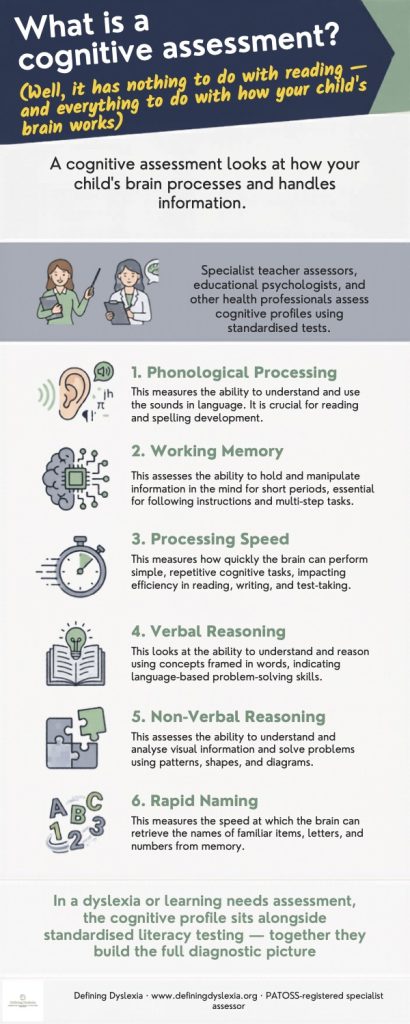
A cognitive assessment looks at how your child's brain processes and handles information. It is not a test of intelligence, and it has nothing to do with reading ability in isolation. Instead, it examines the underlying cognitive skills that support learning — the building blocks that make reading, writing, spelling, and understanding possible in the first place.
Specialist teacher assessors, educational psychologists, and other health professionals all use standardised cognitive tests as part of a comprehensive assessment. These tests have been developed and validated through research, meaning the results can be compared against what is typical for a child of the same age.
What does a cognitive assessment actually measure?
There are six key areas that a cognitive assessment typically explores:
Phonological processing measures the ability to understand and use the sounds in language. It is one of the most important predictors of reading and spelling development — and one of the areas most commonly affected in dyslexia.
Working memory assesses the ability to hold and manipulate information in the mind for short periods. If your child forgets instructions the moment you give them, loses track mid-task, or struggles with multi-step activities, working memory is likely playing a significant role.
Processing speed measures how quickly the brain can perform simple, repetitive cognitive tasks. A slower processing speed affects efficiency across reading, writing, and test-taking — and often explains why a bright child takes significantly longer than their peers to complete work.
Verbal reasoning looks at the ability to understand and reason using concepts framed in words. It reflects language-based problem-solving skills and often gives a strong indication of a child's underlying intellectual ability — particularly important where written output doesn't reflect what a child actually knows.
Non-verbal reasoning assesses the ability to understand and analyse visual information, solving problems using patterns, shapes, and diagrams. A strong non-verbal profile alongside weaker verbal or literacy scores is a common pattern in dyslexia.
Rapid naming measures the speed at which the brain retrieves the names of familiar items, letters, and numbers from memory. Difficulties here are strongly associated with dyslexia and affect the fluency and automaticity of reading.
Why does the cognitive profile matter?
Because it tells the full story. A literacy assessment alone can tell you that a child is struggling with reading and spelling. A cognitive assessment tells you why — and that distinction is everything when it comes to putting the right support in place.
In a dyslexia or learning needs assessment, the cognitive profile sits alongside standardised literacy testing. Together they build the full diagnostic picture — one that can identify dyslexia, highlight co-occurring difficulties, and point toward genuinely targeted recommendations.
Additionally, the cognitive profile often reveals strengths that go unrecognised in a classroom setting. A child who appears to be struggling across the board may have exceptional non-verbal reasoning or strong verbal ability — strengths that, once identified, can be built upon and celebrated.
Does my child need a cognitive assessment?
If your child is struggling with reading, writing, spelling, or learning in ways that don't seem to respond to normal classroom support, a cognitive assessment is a valuable next step. It is particularly useful where there is a mismatch between what a child appears capable of verbally and what they produce in written work — a pattern that is very common in dyslexia.
It is also worth considering for children whose difficulties are inconsistent or hard to pin down. The cognitive profile can often explain patterns of behaviour and performance that have previously seemed puzzling or contradictory.

How Defining Dyslexia can help
At Defining Dyslexia, we offer full diagnostic SpLD assessments for children and adults across Sheffield, South Yorkshire, and Peterborough, with remote assessments available across the UK. Every assessment includes time at the end to talk through findings together, so you leave with a clear understanding of the results, not just a document to decipher on your own.
If you have questions about your child's scores, or you are wondering whether an assessment might be the right next step, we are happy to have an initial conversation. There is no obligation, and sometimes a short chat is all it takes to feel clearer about where to go next.
You can get in touch via the contact page at https://www.definingdyslexia.org/contact-us/