How Do I Get My Child Assessed for Dyslexia in the UK? A Parent's Guide
If you've found yourself searching for answers about your child's reading, writing, or spelling difficulties, you're not alone. Many parents reach a point where they know something isn't quite right but aren't sure where to turn. This guide aims to walk you through the assessment process clearly and honestly.
Additionally, if you prefer to watch rather than read, I have a video and a downloadable guide that cover many of these same questions, links are below.
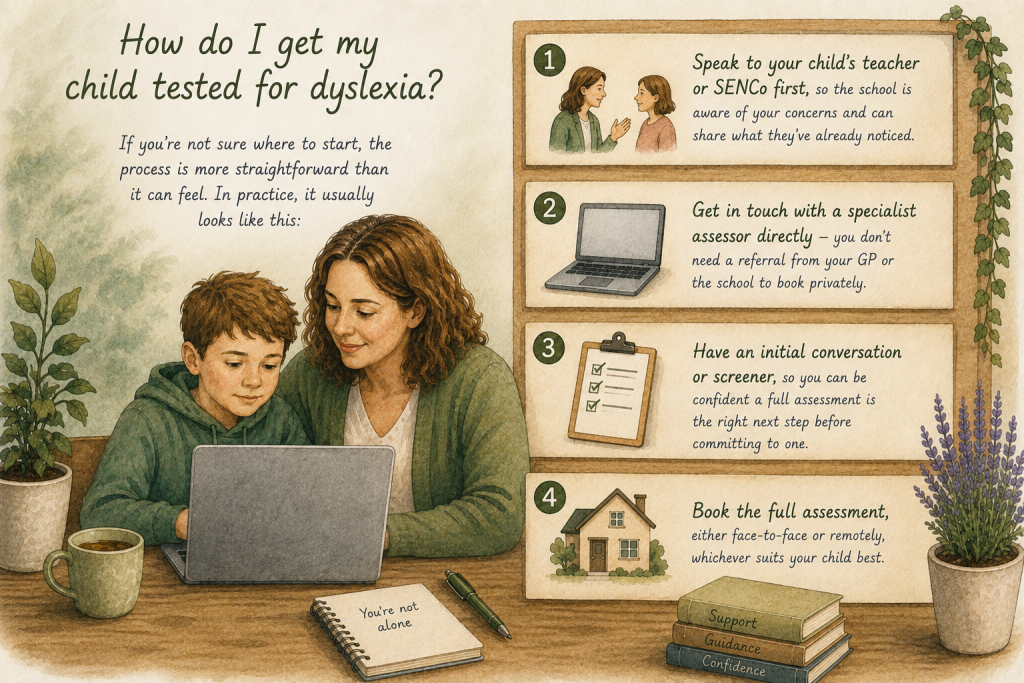
How do I get my child tested for dyslexia?
If you're not sure where to start, the process is more straightforward than it can feel. In practice, it usually looks like this:
- Speak to your child's teacher or SENCo first, so the school is aware of your concerns and can share what they've already noticed.
- Get in touch with a specialist assessor directly — you don't need a referral from your GP or the school to book privately.
- Have an initial conversation or screener, so you can be confident a full assessment is the right next step before committing to one.
- Book the full assessment, either face-to-face or remotely, whichever suits your child best.
Additionally, if your child's school has already carried out its own screening and the results came back inconclusive, that's not a reason to rule out dyslexia. It simply means a fuller picture is needed, which is exactly what a formal assessment provides.
What is a dyslexia assessment?
A dyslexia assessment is a detailed, one-to-one evaluation carried out by a specialist assessor. It looks at a range of skills including reading, spelling, writing speed, phonological processing, and memory. The aim isn't simply to confirm or rule out dyslexia — it's to build a clear picture of how your child thinks, learns, and processes information, so that the right support can be put in place.
What does the assessment involve, and how long does it take?
A typical assessment covers areas such as reading accuracy, reading fluency, spelling, writing, and cognitive processing. It isn't a test your child can pass or fail — it's simply a way of gathering information, and most children find it far less daunting than they expect.
Most assessments take around two to three hours in a single sitting. However, for children who find extended sessions difficult, it's entirely possible to split the assessment across several shorter sessions. This is something I offer where needed, and it can make a significant difference to how comfortable and settled a child feels throughout the process.
Does my child need a formal assessment?
Not every child who struggles with reading has dyslexia, and not every child with dyslexia needs a formal report. However, a formal assessment becomes particularly important when school support hasn't made a significant difference, when your child is approaching exam years and may need access arrangements, or when you simply need clarity after months or years of uncertainty.
Many assessors, myself included, offer an initial screener before committing to a full assessment. This is a shorter, lower-cost conversation and review that helps establish whether a full assessment is genuinely the right next step. I offer this as standard because I want families to feel confident they're investing in something that will make a real difference.
Does my child have to be a certain age?
Generally speaking, eight years old is considered the point at which a formal dyslexia assessment becomes most meaningful and reliable. Assessments carried out before this age are harder to interpret and are unlikely to produce a report that holds up in later life without being repeated. There are exceptions to this, however, so if you have concerns about a younger child it's always worth getting in touch to discuss the individual situation.
Can the school carry out the assessment?
Schools can identify and support children with learning difficulties, but they cannot diagnose dyslexia. Most schools do not employ a specialist teacher with the qualifications needed to conduct a formal SpLD assessment. A formal assessment must be carried out by a specialist assessor who holds an Assessment Practising Certificate (APC) — this is the recognised qualification in the UK.
Additionally, for any assessment to be used for exam access arrangements such as extra time, it must meet specific criteria set out by the Joint Council for Qualifications (JCQ).
Most schools will not fund a dyslexia assessment, though it is always worth asking as some do in certain circumstances. What schools are required to do is put appropriate accommodations in place once a dyslexia assessment has been completed. Many schools are genuinely positive partners in this process and are happy to be involved, and involving them early often leads to better outcomes for the child.
Does it matter whether the assessment is in person or online?
If you're searching for a private dyslexia assessment for your child near you, here's what's available.
In short, what matters most is what works best for you and your child. Face-to-face assessments suit many families, particularly where a child benefits from a familiar, settled environment with someone physically present. Remote assessments are equally valid and can be a practical option for families where travel is difficult or where flexibility matters.
At Defining Dyslexia, face-to-face assessments are available across Sheffield and South Yorkshire, and across Peterborough and Cambridgeshire. Remote assessments are available for families anywhere across the UK. Whichever option you choose, the quality and content of the assessment remains the same.
How do I find a qualified assessor?
The most reliable way is to search the PATOSS Assessor Link or the British Dyslexia Association's directory. Both list assessors who hold the required qualifications and practising certificates. It's worth checking that your chosen assessor holds a valid and current APC, as these require regular renewal.
What happens after the assessment?
You'll receive a written report outlining your child's profile of strengths and difficulties, along with clear recommendations for school, home, and where relevant, exam access arrangements. A good report should be practical and readable — not just a list of scores.
How much does a dyslexia assessment cost?
Private, Independent assessments typically range from around £400 to £600, depending on the assessor and the complexity of the assessment. Some schools and local authorities fund assessments in certain circumstances, so it's always worth asking - though many families do choose to go privately to avoid long waits.
To find out or transparent and honest pricing follow this link
Where do I find out more?
Well, have a look at our handy guides.....
Click here to go to our free resources page for more information and guides.
A final word
A note on value. We understand that the cost of an assessment can feel like a significant outlay, particularly when families are already navigating a stressful and uncertain time. What a thorough, well-written assessment offers is not just a diagnosis (it is clarity, direction, and a professional voice advocating for your child). Many families describe it as one of the most useful investments they have made in their child's education.
How Defining Dyslexia can help
At At Defining Dyslexia, we offer full diagnostic SpLD assessments for children and adults across Sheffield, South Yorkshire, and Peterborough, with remote assessments available across the UK. Every assessment includes time at the end to talk through findings together, so you leave with a clear understanding of the results, not just a document to decipher on your own.
If you have questions about your child's scores, or you are wondering whether an assessment might be the right next step, we are happy to have an initial conversation. There is no obligation, and sometimes a short chat is all it takes to feel clearer about where to go next.
You can get in touch via the contact page at https://www.definingdyslexia.org/contact-us/